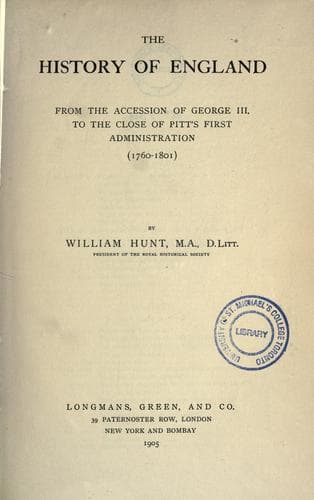
The history of England, from the accession of George III. to the close of Pitt's first administration, 1760-1801Hunt, William
History
The history of England, from the accession of George III. to the close of Pitt's first administration, 1760-1801
Hunt, William
Great Britain -- History -- George III, 1760-1820
He was succeeded as secretary of state by Lord Egremont, a man of small
ability; the leadership of the commons was committed to Grenville, and
Bedford took Temple's place as privy seal. Events soon vindicated the
wisdom of Pitt's demand for instant war with Spain. Bristol in vain
demanded satisfactory assurances from that court. At first Wall's
answers were conciliatory, but naval preparations still went on. By
November 2 all the treasure-ships had arrived safely. Their arrival
caused a marked change in Wall's tone; he no longer disguised the
hostile feeling of his court. At Christmas the Family Compact was
published. It was of the same character as the compacts of 1733 and
1743, and arranged a strict alliance between the sovereigns of the house
of Bourbon. It was formed between the Kings of France and Spain, the
King of Spain also engaging for the King of the Two Sicilies, and it
guaranteed the dominions of the three kings and of the Duke of Parma.
Each sovereign was to send specified assistance to any of the others who
might require it, but wars undertaken by France in consequence of
engagements to German or northern states were not to be cases in which
Spain should be bound to send help, "unless some maritime power should
take part in them". These words pointed directly to Great Britain. On
January 2, 1762, war was declared against Spain. France and Spain forced
our ally, the King of Portugal, to declare war, and in the spring Spain
invaded his kingdom.
This new war afforded Bedford an opportunity for moving in parliament
for the recall of the British troops from Germany. Bute, though equally
desirous for their recall, opposed the motion as inopportune;
circumstances, he said, had arisen which promised to enable us to lessen
expenses and reduce the war. The motion was lost. The declaration of
disagreement between two cabinet ministers on so serious a question
illustrates the difference between the cabinet system of the time and
that of to-day. The circumstances to which Bute referred were the death
of Frederick's enemy, Elizabeth of Russia, on January 5, and the
accession of Peter III., who was his ardent admirer. Peter restored East
Prussia to Frederick, ordered Tchernitchev and his 20,000 men to
withdraw from Glatz, and entered into negotiations for an alliance with
Prussia, which was concluded later. Frederick's position was totally
changed. Bute hoped that he would use this change of fortune to make
peace; it naturally caused him to be more eager to prosecute the war for
Silesia. When he applied for the renewal of the English subsidy of
L670,000, Bute informed him that it would only be granted on condition
that he gave assurances that he was ready to make peace. This Frederick
would not do. Other difficulties arose between the two courts. Bute
complained that Frederick was secretly negotiating with Russia for a
separate treaty which would hinder a general peace, and thwart our
Public-domain text, read in full here on John Shaqi.
Reviews
Reviews
No reviews yet
Be the first to share your thoughts on this work.
Join the Discussion
Join the discussion
Sign in to leave a comment or review.
Sign InorCreate an account