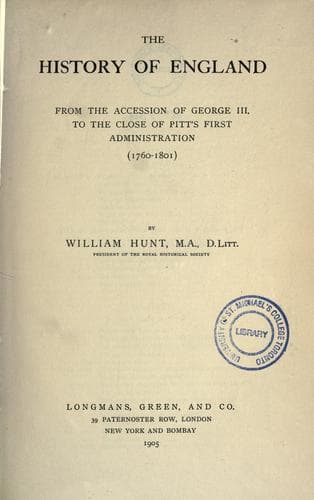
The history of England, from the accession of George III. to the close of Pitt's first administration, 1760-1801Hunt, William
History
The history of England, from the accession of George III. to the close of Pitt's first administration, 1760-1801
Hunt, William
Great Britain -- History -- George III, 1760-1820
policy in the north by encouraging Russia to enforce the surrender of
Schleswig. Frederick also had his complaints. Early in the year Bute
made certain efforts for a general peace, and Frederick asserted that
Bute had suggested that Russia should force him to surrender Silesia to
Austria. Bute was deceived as regards the tsar's intentions, and his
words were spoken in the interest of Prussia. Nevertheless, Frederick
would not be pacified, and he further accused Bute of trying to dissuade
Peter from making an alliance with him. This charge was flatly denied by
Bute. It rests solely on the assertion of Prince Galitzin, the Russian
ambassador in London, and there is no reason for doubting Bute's
word.[54] As Frederick refused to give any pledge as to the terms on
which he would make peace, the British government refused the subsidy.
Pitt having been driven from office, the king and Bute turned upon
Newcastle. Bute and Grenville treated him with discourtesy; he found
himself deprived of the power of dispensing patronage; the king did not
even consult him as to the new peerages granted in the spring. As an old
whig he set a high value on the continental connexion formed by the
alliance with Frederick, and cared more for the war in Europe than for
naval expeditions. He was deeply annoyed by the desire of Bute,
Grenville, and Bedford to withdraw our troops from Germany and by the
refusal of the subsidy. He would not, he declared, "be Grenville's tool
and load the nation with four or five millions to carry on a ridiculous,
destructive maritime war".[55] Nevertheless he clung to office.
Devonshire and Hardwicke agreed with him, and attached themselves to a
section of the whigs who acknowledged the Duke of Cumberland as their
head. Newcastle proposed that a vote of L2,000,000 should be asked for,
L1,000,000 as usual for the German war and L1,000,000 for the war in
Portugal. Bute and Grenville maintained that only L1,000,000 was wanted.
That, he said, implied the abandonment of the German war. The question
was decided against him in a cabinet meeting on May 4. Bitterly as he
felt this defeat on a matter concerning his own office, the treasury, he
would not do more than threaten to resign, and found an excuse for
retaining office for the present. George and Bute were determined that
he should go; George was ungracious, Bute uncivil. His friends urged him
to resign. At last he brought himself to the point and resigned on the
25th.[56]
[Sidenote: _BUTE'S ADMINISTRATION._]
Public-domain text, read in full here on John Shaqi.
Reviews
Reviews
No reviews yet
Be the first to share your thoughts on this work.
Join the Discussion
Join the discussion
Sign in to leave a comment or review.
Sign InorCreate an account