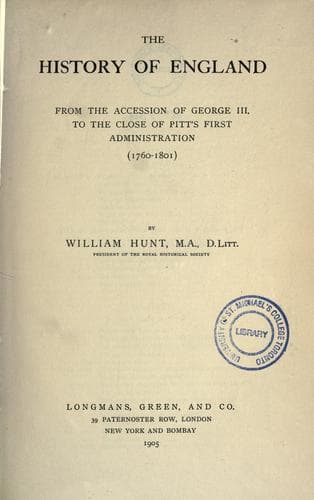
The history of England, from the accession of George III. to the close of Pitt's first administration, 1760-1801Hunt, William
History
The history of England, from the accession of George III. to the close of Pitt's first administration, 1760-1801
Hunt, William
Great Britain -- History -- George III, 1760-1820
The unpopularity of the administration was heightened by its finance.
Dashwood's scheme for the supplies included a loan of L3,000,000, which
was negotiated on such extravagant terms that the scrip soon rose to a
premium of 11 per cent. The loan was not open to public competition, it
was distributed among the chief supporters of the government; nine of
them, it is said, cleared each L20,000, Fox L10,000, and so on, while
the nation lost L385,000 by the transaction. It was a new form of
corruption, specially dangerous because indirect.[62] More general
indignation was excited by the proposal of a tax of four shillings a
hogshead on cider, to be paid by the maker and collected as an excise.
The tax was excessive in amount, onerous in its conditions, and unfair
in its incidence, for it fell equally on the poorest and the most
valuable cider, and pressed solely on particular districts. It was,
however, as an extension of the excise laws that it was specially
offensive to public feeling. That was a matter on which Englishmen were
extremely jealous. Thirty years before a proposal for an extended excise
nearly wrecked the power of Sir Robert Walpole, who wisely yielded to
the storm. By Dashwood's scheme farmers were liable to have the privacy
of their homes invaded by the visits of excisemen. Disturbances broke
out in the cider counties, and troops were moved into them. The
excitement was general. London petitioned against the tax, and its
example was followed by many other corporations and counties. Bute was
violently assailed in print, by Wilkes in prose and by his friend
Churchill in verse. A parliamentary opposition was organised; it was
joined by Pitt and Temple, and had its headquarters at Wildman's tavern
in Albemarle Street. Pitt spoke strongly against the tax in the commons.
It was defended by Grenville, who in the course of his speech constantly
demanded where another tax could be laid. Mimicking his querulous tone,
Pitt repeated aloud the words of an old ditty, "Gentle shepherd, tell me
where". The nickname, Gentle shepherd, stuck by Grenville. The bill
passed the commons and was sent up to the lords. For the first time
since the revolution the lords divided on a money-bill, and voted 49
against, to 83 for its committal.
Public-domain text, read in full here on John Shaqi.
Reviews
Reviews
No reviews yet
Be the first to share your thoughts on this work.
Elsewhere in the archive
Join the Discussion
Join the discussion
Sign in to leave a comment or review.
Sign InorCreate an account