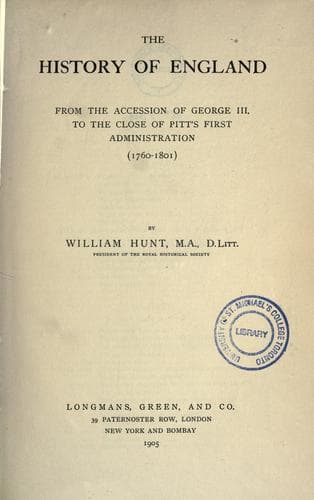
The history of England, from the accession of George III. to the close of Pitt's first administration, 1760-1801Hunt, William
History
The history of England, from the accession of George III. to the close of Pitt's first administration, 1760-1801
Hunt, William
Great Britain -- History -- George III, 1760-1820
George seems to have changed his mind; he told Grenville that Pitt's
terms were too hard. Bute is said to have instigated this change, and it
is probable that both he and the king were disappointed at finding that
Pitt meant to bring in with him several of the whig leaders. Pitt had a
second interview with the king on the 29th, and George is said to have
closed it with the words: "Well, Mr. Pitt, I see this will not do. My
honour is concerned and I must support it." Pitt's proposals were
probably exaggerated by the ministerial party. It is certain that he
proposed several changes, and the admission of some of the leading
whigs, and that either he or the king suggested Temple for the treasury.
George had made up his mind before the interview that it would probably
be useless. Both he and Bute would gladly have secured Pitt's support,
but they wanted him to take office alone, or at least not with a party.
George had no mind for another whig administration with Pitt as its
master-spirit.
He again turned to Bedford and told him that Pitt had stipulated that he
was to have no office, even about the court, at that time, though in
future years he might be permitted to hold a court appointment, and that
no favour should be shown to any one concerned in the peace. George may
well have believed that this was the meaning of Pitt's words. Even so,
he should not have divulged anything which took place in his closet,
specially if it was likely to make mischief; he was, however, in serious
difficulties. His device succeeded. Though Bedford was already aware
that Pitt would not act with him, he was piqued at this fresh
declaration of hostility; he agreed to take office, and, on September 9,
was appointed president of the council in succession to Lord Granville
who died in the previous January. He was considered head of the
administration. The Earl of Sandwich became secretary of state and took
the northern department, and Lord Hillsborough succeeded Lord Shelburne
as president of the board of trade. Sandwich had official experience,
and was neither idle nor incapable, though unprincipled and extremely
profligate; Hillsborough was deficient in tact and judgment. Shelburne
had been one of Bute's followers, and arranged his bargains with Fox,
who accused him of having deceived him. He was employed in the late
negotiations with Pitt, resigned office on their failure, and attached
himself to Pitt. The king was completely in the hands of Bedford and
Grenville, his only defence against an administration composed of whig
magnates. They used their power to force him to send Bute out of London.
This insolent conduct was specially reprehensible in the case of
Grenville, who owed his advancement to Bute's recommendation. Grenville
continued to weary the king with interviews; he worried him with his
disputes with his colleagues, and irritated him beyond endurance by
suggestions, which were not ill-founded, that he was still under Bute's
influence. "Good God, Mr.
Public-domain text, read in full here on John Shaqi.
Reviews
Reviews
No reviews yet
Be the first to share your thoughts on this work.
Elsewhere in the archive
Join the Discussion
Join the discussion
Sign in to leave a comment or review.
Sign InorCreate an account