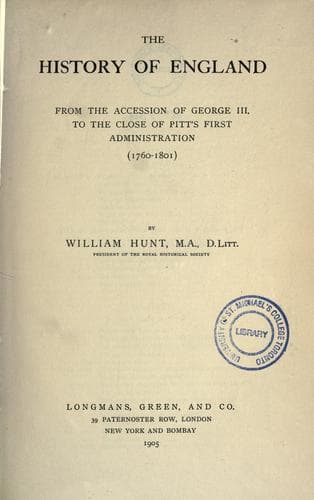
The history of England, from the accession of George III. to the close of Pitt's first administration, 1760-1801Hunt, William
History
The history of England, from the accession of George III. to the close of Pitt's first administration, 1760-1801
Hunt, William
Great Britain -- History -- George III, 1760-1820
Grenville adopted a new policy apparently contemplated by Bute's ministry.
Hitherto parliament had imposed customs duties on the colonies solely for
the purpose of regulating trade; he designed to raise revenue from them.
The idea was suggested to Walpole as a means of obtaining money on the
failure of his excise scheme, and that wary statesman promptly rejected
it. The money, however, which Grenville hoped to raise from the colonies
was not to swell the revenues of England; it was to be applied to their
own defence. His design was reasonable. The war had enormously increased
the public debt. It is true that it was not undertaken only for the
defence of the colonies; it is not less true that it was not a merely
insular war. The war concerned the empire at large, and Great Britain's
lavish sacrifices of blood and treasure delivered her children across the
ocean from the fear of French conquest. Her expenditure on their defence
could not end with the war; a small standing army had to be maintained for
their protection. It seemed not unlikely that France would attempt to
regain her lost dominions; it would have been fatal to leave the American
colonies undefended. And another foe was always at hand, for the Indians
regretted the overthrow of the French and were exasperated by the
ill-treatment they received from the British colonists. In 1763 Pontiac,
head-chief of the Ottawas, formed a confederation against the English.
Along the borders of Pennsylvania, Virginia, and Maryland the Indians
massacred outlying settlers, surprised many forts and slew their
garrisons. Three provinces might have been overrun before the inhabitants
had organised any defence, had not Sir Jeffrey (later Lord) Amherst, the
commander-in-chief, had a small British force at his disposal, consisting
mainly of companies of the 7th, 42nd, and 77th regiments of the line, and
of the Royal American regiment (later the 60th Rifles), formed in 1755 for
service in America. A little army composed largely of men of the 42nd
Highlanders, and commanded by Colonel Bouquet, defeated the Indians at
Bushy Run on August 5. Fort Pitt was relieved and, the victory having
encouraged the provincials to make a stand, the war virtually ended in
November, 1764.
[Sidenote: _THE STAMP ACT PROPOSED._]
Public-domain text, read in full here on John Shaqi.
Reviews
Reviews
No reviews yet
Be the first to share your thoughts on this work.
Elsewhere in the archive
Join the Discussion
Join the discussion
Sign in to leave a comment or review.
Sign InorCreate an account