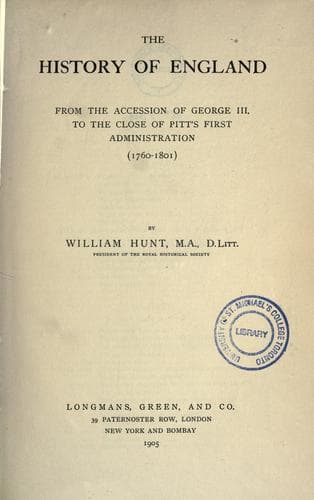
The history of England, from the accession of George III. to the close of Pitt's first administration, 1760-1801Hunt, William
History
The history of England, from the accession of George III. to the close of Pitt's first administration, 1760-1801
Hunt, William
Great Britain -- History -- George III, 1760-1820
In an interview with the agents of the colonies Grenville pointed out
that the tax was reasonable, and was an easy and equitable way of
raising the required money, but promised that if the colonies disliked
it, and would raise the money themselves in some other way, he would be
content. Before the year was out they met him again and, acting on
instructions from their colonies, tried to dissuade him from his
purpose. Chief among them was Benjamin Franklin, then agent for
Pennsylvania, a New Englander by birth, not a puritan either in religion
or morals, a wise politician, shrewd, public-spirited, inventive, and
full of schemes of practical usefulness. He proposed that the money
should be voted by the provincial assemblies, but could not say that the
colonies would agree as to the amount which each should contribute. On
that of course the whole matter depended. When Grenville brought in his
stamp bill the debate, Burke says, was extremely languid. Parliament had
no idea that the act would lead to serious consequences. Nor were the
American agents much better informed, for Franklin, who considered that
a small standing army might be useful, believed that the colonies had no
choice but to submit to the tax. Pitt was absent from parliament,
suffering from gout. Conway and Barre opposed the bill, and Barre, in a
speech of fervid eloquence, described the Americans as "sons of
liberty," driven from their country by tyranny and treated by her with
neglect. In the commons the bill was carried with only forty
dissentients, and in the lords apparently without a division. It
received the royal assent on March 22, 1765, and was to come into
operation on November 1. In April the mutiny act was extended to
America, binding the colonies to provide the king's troops with quarters
and certain necessaries, such as fuel and candles.
[Sidenote: _AMERICAN RESISTANCE._]
Public-domain text, read in full here on John Shaqi.
Reviews
Reviews
No reviews yet
Be the first to share your thoughts on this work.
Elsewhere in the archive
Join the Discussion
Join the discussion
Sign in to leave a comment or review.
Sign InorCreate an account