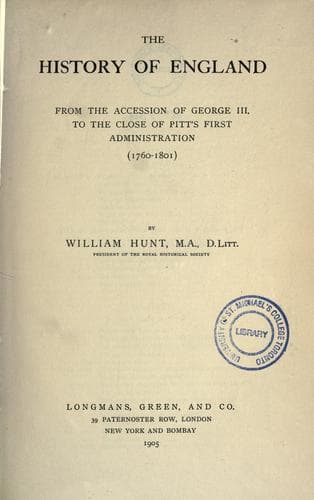
The history of England, from the accession of George III. to the close of Pitt's first administration, 1760-1801Hunt, William
History
The history of England, from the accession of George III. to the close of Pitt's first administration, 1760-1801
Hunt, William
Great Britain -- History -- George III, 1760-1820
On Pitt's refusal to take office, Cumberland tried Lord Lyttelton and
Charles Townshend, but they declined the king's offer because they
believed that no strong administration was possible without Pitt. George
was forced to beg his ministers to continue. They took full advantage of
his humiliation. Pitt had asked for assurances on matters of public
policy; they made stipulations which chiefly concerned persons. The king
must promise never again to consult Bute, and must deprive his brother
Mackenzie of the office of privy seal of Scotland. As regards Bute,
George at once gave the required promise, and though he was afterwards
constantly suspected of consulting with him, there is good reason to
believe that he loyally kept his word, and that Bute never again offered
him any advice.[71] He had promised Mackenzie his office for life, and
declared "that he should disgrace himself" if he took it from him.
Nevertheless Grenville forced him to give way. His relations with his
ministers were naturally strained; they complained that he did not
support them, and on one occasion Bedford remonstrated with him in
insolent terms. Again George requested Cumberland to treat with Pitt,
who had two interviews with the king and was anxious to accept his
offer, but Temple peremptorily refused to take any office, even the
treasury, and Pitt with deep regret again followed his lead. The king
found no way of escape, save by authorising Cumberland to turn to the
great whig families. Grenville was dismissed, and an administration
formed under the leadership of the Marquis of Rockingham took office on
July 16. It must have been a bitter humiliation to George after all that
had passed. Yet, though for the moment he was defeated, he did not mean
to give over the rule of his kingdom to the whigs, and for the present
anything was better than Grenville's tyranny. George respected his
character, but said he, "I would rather see the devil in my closet than
Mr. Grenville".
Public-domain text, read in full here on John Shaqi.
Reviews
Reviews
No reviews yet
Be the first to share your thoughts on this work.
Elsewhere in the archive
Join the Discussion
Join the discussion
Sign in to leave a comment or review.
Sign InorCreate an account