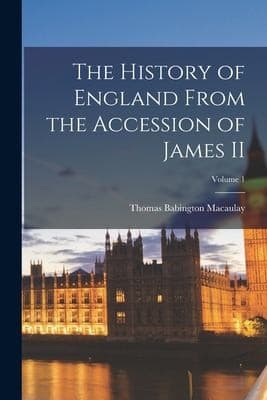
The History of England, from the Accession of James II — Volume 1Macaulay, Thomas Babington Macaulay, Baron
History
The History of England, from the Accession of James II — Volume 1
Macaulay, Thomas Babington Macaulay, Baron
Great Britain -- History -- James II, 1685-1688; Great Britain -- History -- William and Mary, 1689-1702
The military tyranny had passed away; but it had left deep and enduring
traces in the public mind. The name of standing army was long held in
abhorrence: and it is remarkable that this feeling was even stronger
among the Cavaliers than among the Roundheads. It ought to be considered
as a most fortunate circumstance that, when our country was, for the
first and last time, ruled by the sword, the sword was in the hands,
not of legitimate princes, but of those rebels who slew the King and
demolished the Church. Had a prince with a title as good as that of
Charles, commanded an army as good as that of Cromwell, there would
have been little hope indeed for the liberties of England. Happily that
instrument by which alone the monarchy could be made absolute became an
object of peculiar horror and disgust to the monarchical party, and long
continued to be inseparably associated in the imagination of Royalists
and Prelatists with regicide and field preaching. A century after the
death of Cromwell, the Tories still continued to clamour against every
augmentation of the regular soldiery, and to sound the praise of a
national militia. So late as the year 1786, a minister who enjoyed no
common measure of their confidence found it impossible to overcome their
aversion to his scheme of fortifying the coast: nor did they ever look
with entire complacency on the standing army, till the French Revolution
gave a new direction to their apprehensions.
The coalition which had restored the King terminated with the danger
from which it had sprung; and two hostile parties again appeared
ready for conflict. Both, indeed, were agreed as to the propriety of
inflicting punishment on some unhappy men who were, at that moment,
objects of almost universal hatred. Cromwell was no more; and those who
had fled before him were forced to content themselves with the miserable
satisfaction of digging up, hanging, quartering, and burning the remains
of the greatest prince that has ever ruled England.
Public-domain text, read in full here on John Shaqi.
Reviews
Reviews
No reviews yet
Be the first to share your thoughts on this work.
Elsewhere in the archive
Join the Discussion
Join the discussion
Sign in to leave a comment or review.
Sign InorCreate an account