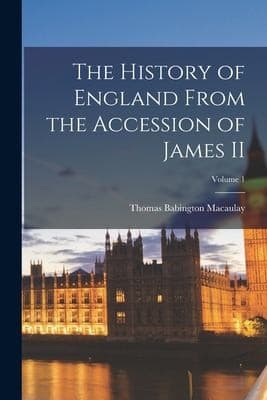
The History of England, from the Accession of James II — Volume 1Macaulay, Thomas Babington Macaulay, Baron
History
The History of England, from the Accession of James II — Volume 1
Macaulay, Thomas Babington Macaulay, Baron
Great Britain -- History -- James II, 1685-1688; Great Britain -- History -- William and Mary, 1689-1702
One of the devices to which he resorted for the purpose of obtaining an
ascendency in the English counsels deserves especial notice. Charles,
though incapable of love in the highest sense of the word, was the
slave of any woman whose person excited his desires, and whose airs and
prattle amused his leisure. Indeed a husband would be justly derided
who should bear from a wife of exalted rank and spotless virtue half the
insolence which the King of England bore from concubines who, while they
owed everything to his bounty, caressed his courtiers almost before his
face. He had patiently endured the termagant passions of Barbara Palmer
and the pert vivacity of Eleanor Gwynn. Lewis thought that the
most useful envoy who could be sent to London, would be a handsome,
licentious, and crafty Frenchwoman. Such a woman was Louisa, a lady of
the House of Querouaille, whom our rude ancestors called Madam Carwell.
She was soon triumphant over all her rivals, was created Duchess of
Portsmouth, was loaded with wealth, and obtained a dominion which ended
only with the life of Charles.
The most important conditions of the alliance between the crowns were
digested into a secret treaty which was signed at Dover in May, 1670,
just ten years after the day on which Charles had landed at that very
port amidst the acclamations and joyful tears of a too confiding people.
By this treaty Charles bound himself to make public profession of the
Roman Catholic religion, to join his arms to those of Lewis for the
purpose of destroying the power of the United Provinces, and to employ
the whole strength of England, by land and sea, in support of the rights
of the House of Bourbon to the vast monarchy of Spain. Lewis, on the
other hand, engaged to pay a large subsidy, and promised that, if any
insurrection should break out in England, he would send an army at his
own charge to support his ally.
This compact was made with gloomy auspices. Six weeks after it had
been signed and sealed, the charming princess, whose influence over her
brother and brother in law had been so pernicious to her country, was
no more. Her death gave rise to horrible suspicions which, for a moment,
seemed likely to interrupt the newly formed friendship between the
Houses of Stuart and Bourbon: but in a short time fresh assurances of
undiminished good will were exchanged between the confederates.
Public-domain text, read in full here on John Shaqi.
Reviews
Reviews
No reviews yet
Be the first to share your thoughts on this work.
Elsewhere in the archive
Join the Discussion
Join the discussion
Sign in to leave a comment or review.
Sign InorCreate an account