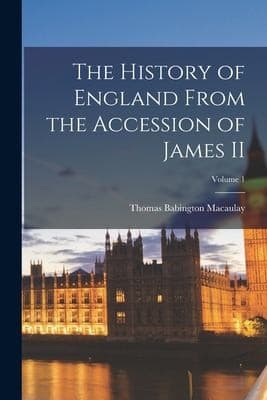
The History of England, from the Accession of James II — Volume 1Macaulay, Thomas Babington Macaulay, Baron
History
The History of England, from the Accession of James II — Volume 1
Macaulay, Thomas Babington Macaulay, Baron
Great Britain -- History -- James II, 1685-1688; Great Britain -- History -- William and Mary, 1689-1702
Henry Bennet, Lord Arlington, then Secretary of State, had since he came
to manhood, resided principally on the Continent, and had learned that
cosmopolitan indifference to constitutions and religions which is often
observable in persons whose life has been passed in vagrant diplomacy.
If there was any form of government which he liked it was that of
France. If there was any Church for which he felt a preference, it was
that of Rome. He had some talent for conversation, and some talent also
for transacting the ordinary business of office. He had learned, during
a life passed in travelling and negotiating, the art of accommodating
his language and deportment to the society in which he found himself.
His vivacity in the closet amused the King: his gravity in debates and
conferences imposed on the public; and he had succeeded in attaching to
himself, partly by services and partly by hopes, a considerable number
of personal retainers.
Buckingham, Ashley, and Lauderdale were men in whom the immorality which
was epidemic among the politicians of that age appeared in its most
malignant type, but variously modified by greet diversities of temper
and understanding. Buckingham was a sated man of pleasure, who had
turned to ambition as to a pastime. As he had tried to amuse himself
with architecture and music, with writing farces and with seeking for
the philosopher's stone, so he now tried to amuse himself with a secret
negotiation and a Dutch war. He had already, rather from fickleness
and love of novelty than from any deep design, been faithless to every
party. At one time he had ranked among the Cavaliers. At another
time warrants had been out against him for maintaining a treasonable
correspondence with the remains of the Republican party in the city. He
was now again a courtier, and was eager to win the favour of the King
by services from which the most illustrious of those who had fought and
suffered for the royal house would have recoiled with horror.
Ashley, with a far stronger head, and with a far fiercer and more
earnest ambition, had been equally versatile. But Ashley's versatility
was the effect, not of levity, but of deliberate selfishness. He had
served and betrayed a succession of governments. But he had timed all
his treacheries so well that through all revolutions, his fortunes
had constantly been rising. The multitude, struck with admiration by
a prosperity which, while everything else was constantly changing,
remained unchangeable, attributed to him a prescience almost miraculous,
and likened him to the Hebrew statesman of whom it is written that his
counsel was as if a man had inquired of the oracle of God.
Public-domain text, read in full here on John Shaqi.
Reviews
Reviews
No reviews yet
Be the first to share your thoughts on this work.
Elsewhere in the archive
Join the Discussion
Join the discussion
Sign in to leave a comment or review.
Sign InorCreate an account