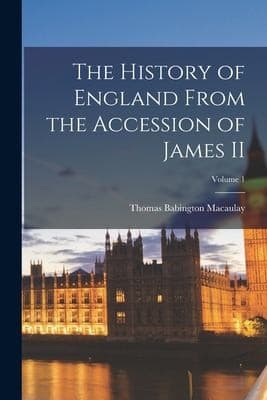
The History of England, from the Accession of James II — Volume 1Macaulay, Thomas Babington Macaulay, Baron
History
The History of England, from the Accession of James II — Volume 1
Macaulay, Thomas Babington Macaulay, Baron
Great Britain -- History -- James II, 1685-1688; Great Britain -- History -- William and Mary, 1689-1702
Of the Earl of Essex, then First Commissioner of the Treasury, it is
sufficient to say that he was a man of solid, though not brilliant
parts, and of grave and melancholy character, that he had been connected
with the Country Party, and that he was at this time honestly desirous
to effect, on terms beneficial to the state, a reconciliation between
that party and the throne.
Among the statesmen of those times Halifax was, in genius, the first.
His intellect was fertile, subtle, and capacious. His polished,
luminous, and animated eloquence, set off by the silver tones of
his voice, was the delight of the House of Lords. His conversation
overflowed with thought, fancy, and wit. His political tracts well
deserve to be studied for their literary merit, and fully entitle him
to a place among English classics. To the weight derived from talents so
great and various he united all the influence which belongs to rank and
ample possessions. Yet he was less successful in politics than many who
enjoyed smaller advantages. Indeed, those intellectual peculiarities
which make his writings valuable frequently impeded him in the contests
of active life. For he always saw passing events, not in the point of
view in which they commonly appear to one who bears a part in them,
but in the point of view in which, after the lapse of many years, they
appear to the philosophic historian. With such a turn of mind he
could not long continue to act cordially with any body of men. All the
prejudices, all the exaggerations, of both the great parties in the
state moved his scorn. He despised the mean arts and unreasonable
clamours of demagogues. He despised still more the doctrines of divine
right and passive obedience. He sneered impartially at the bigotry of
the Churchman and at the bigotry of the Puritan. He was equally unable
to comprehend how any man should object to Saints' days and surplices,
and how any man should persecute any other man for objecting to them. In
temper he was what, in our time, is called a Conservative: in theory
he was a Republican. Even when his dread of anarchy and his disdain
for vulgar delusions led him to side for a time with the defenders of
arbitrary power, his intellect was always with Locke and Milton. Indeed,
his jests upon hereditary monarchy were sometimes such as would have
better become a member of the Calf's Head Club than a Privy Councillor
of the Stuarts. In religion he was so far from being a zealot that
he was called by the uncharitable an atheist: but this imputation he
vehemently repelled; and in truth, though he sometimes gave scandal by
the way in which he exerted his rare powers both of reasoning and
of ridicule on serious subjects, he seems to have been by no means
unsusceptible of religious impressions.
Public-domain text, read in full here on John Shaqi.
Reviews
Reviews
No reviews yet
Be the first to share your thoughts on this work.
Elsewhere in the archive
Join the Discussion
Join the discussion
Sign in to leave a comment or review.
Sign InorCreate an account