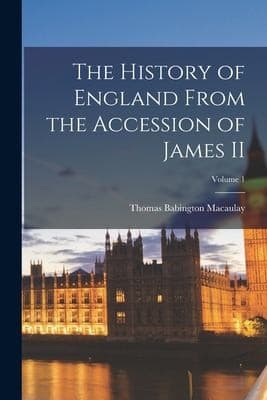
The History of England, from the Accession of James II — Volume 1Macaulay, Thomas Babington Macaulay, Baron
History
The History of England, from the Accession of James II — Volume 1
Macaulay, Thomas Babington Macaulay, Baron
Great Britain -- History -- James II, 1685-1688; Great Britain -- History -- William and Mary, 1689-1702
The party which preponderated in the House of Commons, bitterly
mortified by this defeat, found some consolation in shedding the blood
of Roman Catholics. William Howard, Viscount Stafford, one of the
unhappy men who had been accused of a share in the plot, was impeached;
and on the testimony of Oates and of two other false witnesses, Dugdale
and Turberville, was found guilty of high treason, and suffered death.
But the circumstances of his trial and execution ought to have given an
useful warning to the Whig leaders. A large and respectable minority of
the House of Lords pronounced the prisoner not guilty. The multitude,
which a few months before had received the dying declarations of Oates's
victims with mockery and execrations, now loudly expressed a belief that
Stafford was a murdered man. When he with his last breath protested
his innocence, the cry was, "God bless you, my Lord! We believe you, my
Lord." A judicious observer might easily have predicted that the blood
then shed would shortly have blood.
The King determined to try once more the experiment of a dissolution. A
new Parliament was summoned to meet at Oxford, in March, 1681. Since the
days of the Plantagenets the Houses had constantly sat at Westminster,
except when the plague was raging in the capital: but so extraordinary
a conjuncture seemed to require extraordinary precautions. If the
Parliament were held in its usual place of assembling, the House of
Commons might declare itself permanent, and might call for aid on the
magistrates and citizens of London. The trainbands might rise to defend
Shaftesbury as they had risen forty years before to defend Pym and
Hampden. The Guards might be overpowered, the palace forced, the King a
prisoner in the hands of his mutinous subjects. At Oxford there was no
such danger. The University was devoted to the crown; and the gentry of
the neighbourhood were generally Tories. Here, therefore, the opposition
had more reason than the King to apprehend violence.
The elections were sharply contested. The Whigs still composed a
majority of the House of Commons: but it was plain that the Tory
spirit was fast rising throughout the country. It should seem that the
sagacious and versatile Shaftesbury ought to have foreseen the coming
change, and to have consented to the compromise which the court offered:
but he appears to have forgotten his old tactics. Instead of making
dispositions which, in the worst event, would have secured his retreat,
he took up a position in which it was necessary that he should either
conquer or perish. Perhaps his head, strong as it was, had been turned
by popularity, by success, and by the excitement of conflict. Perhaps
he had spurred his party till he could no longer curb it, and was really
hurried on headlong by those whom he seemed to guide.
Public-domain text, read in full here on John Shaqi.
Reviews
Reviews
No reviews yet
Be the first to share your thoughts on this work.
Elsewhere in the archive
Join the Discussion
Join the discussion
Sign in to leave a comment or review.
Sign InorCreate an account