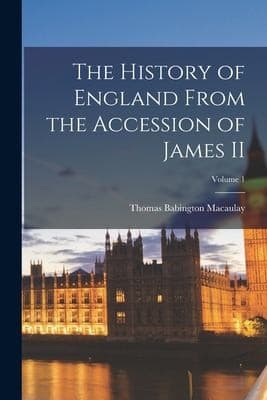
The History of England, from the Accession of James II — Volume 1Macaulay, Thomas Babington Macaulay, Baron
History
The History of England, from the Accession of James II — Volume 1
Macaulay, Thomas Babington Macaulay, Baron
Great Britain -- History -- James II, 1685-1688; Great Britain -- History -- William and Mary, 1689-1702
One of the first objects of an inquirer, who wishes to form a correct
notion of the state of a community at a given time, must be to ascertain
of how many persons that community then consisted. Unfortunately the
population of England in 1685, cannot be ascertained with perfect
accuracy. For no great state had then adopted the wise course of
periodically numbering the people. All men were left to conjecture for
themselves; and, as they generally conjectured without examining facts,
and under the influence of strong passions and prejudices, their guesses
were often ludicrously absurd. Even intelligent Londoners ordinarily
talked of London as containing several millions of souls. It was
confidently asserted by many that, during the thirty-five years
which had elapsed between the accession of Charles the First and the
Restoration the population of the City had increased by two millions.
[27] Even while the ravages of the plague and fire were recent, it was
the fashion to say that the capital still had a million and a half of
inhabitants. [28] Some persons, disgusted by these exaggerations,
ran violently into the opposite extreme. Thus Isaac Vossius, a man of
undoubted parts and learning, strenuously maintained that there were
only two millions of human beings in England, Scotland, and Ireland
taken together. [29]
We are not, however, left without the means of correcting the wild
blunders into which some minds were hurried by national vanity and
others by a morbid love of paradox. There are extant three computations
which seem to be entitled to peculiar attention. They are entirely
independent of each other: they proceed on different principles; and yet
there is little difference in the results.
One of these computations was made in the year 1696 by Gregory King,
Lancaster herald, a political arithmetician of great acuteness and
judgment. The basis of his calculations was the number of houses
returned in 1690 by the officers who made the last collection of the
hearth money. The conclusion at which he arrived was that the population
of England was nearly five millions and a half. [30]
About the same time King William the Third was desirous to ascertain the
comparative strength of the religious sects into which the community
was divided. An inquiry was instituted; and reports were laid before
him from all the dioceses of the realm. According to these reports the
number of his English subjects must have been about five million two
hundred thousand. [31]
Lastly, in our own days, Mr. Finlaison, an actuary of eminent skill,
subjected the ancient parochial registers of baptisms, marriages, and
burials, to all the tests which the modern improvements in statistical
science enabled him to apply. His opinion was, that, at the close of the
seventeenth century, the population of England was a little under five
million two hundred thousand souls. [32]
Public-domain text, read in full here on John Shaqi.
Reviews
Reviews
No reviews yet
Be the first to share your thoughts on this work.
Elsewhere in the archive
Join the Discussion
Join the discussion
Sign in to leave a comment or review.
Sign InorCreate an account