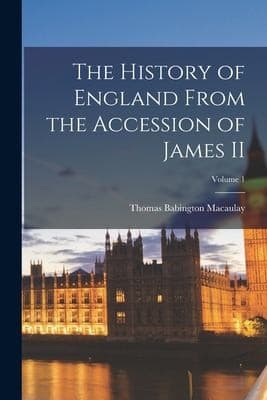
The History of England, from the Accession of James II — Volume 1Macaulay, Thomas Babington Macaulay, Baron
History
The History of England, from the Accession of James II — Volume 1
Macaulay, Thomas Babington Macaulay, Baron
Great Britain -- History -- James II, 1685-1688; Great Britain -- History -- William and Mary, 1689-1702
been well paid if he had received a fourth or fifth part of what would
now be an adequate stipend. In fact, however, the stipends of the
higher class of official men were as large as at present, and not seldom
larger. The Lord Treasurer, for example, had eight thousand a year,
and, when the Treasury was in commission, the junior Lords had sixteen
hundred a year each. The Paymaster of the Forces had a poundage,
amounting, in time of peace, to about five thousand a year, on all the
money which passed through his hands. The Groom of the Stole had five
thousand a year, the Commissioners of the Customs twelve hundred a
year each, the Lords of the Bedchamber a thousand a year each. [60]
The regular salary, however, was the smallest part of the gains of an
official man at that age. From the noblemen who held the white staff and
the great seal, down to the humblest tidewaiter and gauger, what would
now be called gross corruption was practiced without disguise and
without reproach. Titles, places, commissions, pardons, were daily sold
in market overt by the great dignitaries of the realm; and every
clerk in every department imitated, to the best of his power, the evil
example.
During the last century no prime minister, however powerful, has become
rich in office; and several prime ministers have impaired their private
fortune in sustaining their public character. In the seventeenth
century, a statesman who was at the head of affairs might easily, and
without giving scandal, accumulate in no long time an estate amply
sufficient to support a dukedom. It is probable that the income of the
prime minister, during his tenure of power, far exceeded that of any
other subject. The place of Lord Lieutenant of Ireland was popularly
reported to be worth forty thousand pounds a year. [61] The gains of the
Chancellor Clarendon, of Arlington, of Lauderdale, and of Danby, were
certainly enormous. The sumptuous palace to which the populace of London
gave the name of Dunkirk Mouse, the stately pavilions, the fishponds,
the deer park and the orangery of Euston, the more than Italian luxury
of Ham, with its busts, fountains, and aviaries, were among the many
signs which indicated what was the shortest road to boundless wealth.
This is the true explanation of the unscrupulous violence with which the
statesmen of that day struggled for office, of the tenacity with which,
in spite of vexations, humiliations and dangers, they clung to it, and
of the scandalous compliances to which they stooped in order to retain
it. Even in our own age, formidable as is the power of opinion, and
high as is the standard of integrity, there would be great risk of a
lamentable change in the character of our public men, if the place of
First Lord of the Treasury or Secretary of State were worth a hundred
thousand pounds a year. Happy for our country the emoluments of the
highest class of functionaries have not only not grown in proportion to
Public-domain text, read in full here on John Shaqi.
Reviews
Reviews
No reviews yet
Be the first to share your thoughts on this work.
Elsewhere in the archive
Join the Discussion
Join the discussion
Sign in to leave a comment or review.
Sign InorCreate an account