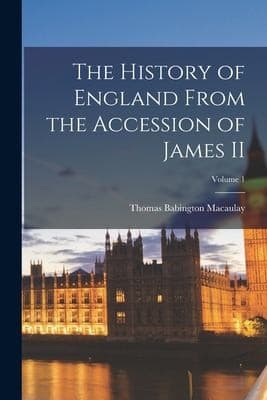
The History of England, from the Accession of James II — Volume 1Macaulay, Thomas Babington Macaulay, Baron
History
The History of England, from the Accession of James II — Volume 1
Macaulay, Thomas Babington Macaulay, Baron
Great Britain -- History -- James II, 1685-1688; Great Britain -- History -- William and Mary, 1689-1702
While the event of the war was still doubtful, the Houses had put the
Primate to death, had interdicted, within the sphere of their authority,
the use of the Liturgy, and had required all men to subscribe that
renowned instrument known by the name of the Solemn League and Covenant.
Covenanting work, as it was called, went on fast. Hundreds of thousands
affixed their names to the rolls, and, with hands lifted up towards
heaven, swore to endeavour, without respect of persons, the extirpation
of Popery and Prelacy, heresy and schism, and to bring to public
trial and condign punishment all who should hinder the reformation of
religion. When the struggle was over, the work of innovation and revenge
was pushed on with increased ardour. The ecclesiastical polity of the
kingdom was remodelled. Most of the old clergy were ejected from their
benefices. Fines, often of ruinous amount, were laid on the Royalists,
already impoverished by large aids furnished to the King. Many estates
were confiscated. Many proscribed Cavaliers found it expedient to
purchase, at an enormous cost, the protection of eminent members of the
victorious party. Large domains, belonging to the crown, to the bishops,
and to the chapters, were seized, and either granted away or put up to
auction. In consequence of these spoliations, a great part of the soil
of England was at once offered for sale. As money was scarce, as the
market was glutted, as the title was insecure and as the awe inspired
by powerful bidders prevented free competition, the prices were often
merely nominal. Thus many old and honourable families disappeared and
were heard of no more; and many new men rose rapidly to affluence.
But, while the Houses were employing their authority thus, it suddenly
passed out of their hands. It had been obtained by calling into
existence a power which could not be controlled. In the summer of
1647, about twelve months after the last fortress of the Cavaliers had
submitted to the Parliament, the Parliament was compelled to submit to
its own soldiers.
Thirteen years followed, during which England was, under various names
and forms, really governed by the sword. Never before that time,
or since that time, was the civil power in our country subjected to
military dictation.
Public-domain text, read in full here on John Shaqi.
Reviews
Reviews
No reviews yet
Be the first to share your thoughts on this work.
Elsewhere in the archive
Join the Discussion
Join the discussion
Sign in to leave a comment or review.
Sign InorCreate an account