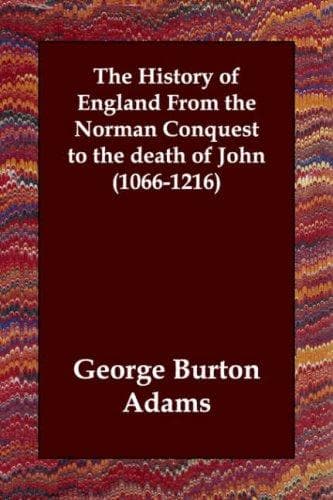
The History of England from the Norman Conquest to the Death of John (1066-1216)Adams, George Burton
History
The History of England from the Norman Conquest to the Death of John (1066-1216)
Adams, George Burton
Great Britain -- History -- Medieval period, 1066-1485
In the year 1098 Magnus, king of Norway, had appeared for a moment with a
hostile fleet off the island of Anglesey. Some reason not certainly known
had brought him round Scotland, perhaps to make an attack on Ireland. He
was the grandson of the King Harold of Norway, who had invaded England on
the eve of the Norman Conquest and perished in the battle of Stamford
Bridge, and he had with him, it is said, a son of Harold of England: to
him the idea of a new invasion of England would not seem strange. At any
rate, after taking possession of the Isle of Man, he came to the help of
the Welsh against the earls, Hugh of Chester and Hugh of Shrewsbury, who
were beginning the conquest of Anglesey. The incident is noteworthy
because, in the brief fighting which occurred, the Earl of Shrewsbury was
slain. His death opened the way for the succession of his brother, Robert
of Bellême, to the great English possessions of their father in Wales,
Shropshire, and Surrey, to which he soon added by inheritance the large
holdings of Roger of Bully in Yorkshire and elsewhere. These
inheritances, when added to the lands, almost a principality in
themselves, which he possessed in southern Normandy and just over the
border in France, made him the most powerful vassal of the English king.
In character he had inherited far more from his tyrannous and cruel
mother, Mabel, daughter of William Talvas of Bellême, than from his more
high-minded father, Roger of Montgomery, the companion of the Conqueror.
As a vassal he was utterly untrustworthy, and he had become too powerful
for his own safety or for that of the king.
Some minor events of these years should be recounted. In 1097 William had
sent Edgar the atheling to Scotland with an army, King Donald had been
overthrown, and Edgar's nephew, himself named Edgar, with the support of
the English king, had been made king. In 1099 Ranulf Flambard received
the reward of his faithful services, and was made Bishop of Durham, in
some respects the most desirable bishopric in England. Greater prospects
still of power and dominion were opened to William a few months before
his death, by the proposition of the Duke of Aquitaine to pledge him his
great duchy for a sum of money to pay the expenses of a crusade. To add
to the lands he already ruled those between the Loire and the Garonne
would be almost to create a new monarchy in France and to threaten more
dangerously at this moment the future of the Capetian kingdom than did
two generations later the actual union of these territories and more
under the king of England.
Public-domain text, read in full here on John Shaqi.
Reviews
Reviews
No reviews yet
Be the first to share your thoughts on this work.
Elsewhere in the archive
Join the Discussion
Join the discussion
Sign in to leave a comment or review.
Sign InorCreate an account