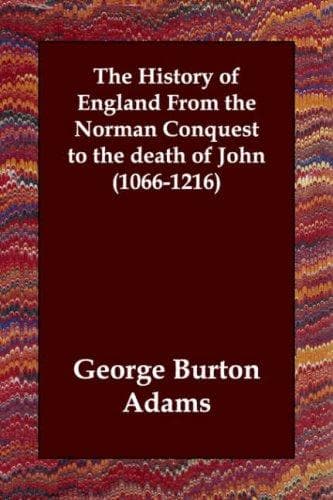
The History of England from the Norman Conquest to the Death of John (1066-1216)Adams, George Burton
History
The History of England from the Norman Conquest to the Death of John (1066-1216)
Adams, George Burton
Great Britain -- History -- Medieval period, 1066-1485
Perhaps in the same spirit, regarding the main point as settled, Henry
now allowed Anselm to hold the council of the English Church which
William Rufus had so long refused him. The council met at Westminster and
adopted a series of canons, whose chief object was the complete carrying
out of the Gregorian reformation in the English Church. The most
important of them concerned the celibacy of the priesthood, and enacted
the strictest demands of the reform party, without regard to existing
conditions. No clerics of any grade from subdeacon upward, were to be
allowed to marry, nor might holy orders be received hereafter without a
previous vow of celibacy. Those already married must put away their
wives, and if any neglected to do so, they were no longer to be
considered legal priests, nor be allowed to celebrate mass. One canon,
which reveals one of the dangers against which the Church sought to guard
by these regulations, forbade the sons of priests to inherit their
father's benefices. It is very evident from these canons, that this part
of the new reformation had made but little, if any, more headway in
England than that which concerned investiture, and we know from other
sources that the marriage of secular clergy was almost the rule, and that
the sons of priests in clerical office were very numerous. Less is said
of the other article of the reform programme, the extinction of the sin
of simony, but three abbots of important monasteries, recently appointed
by the king, were deposed on this ground without objection. This
legislation, so thorough-going and so regardless of circumstances, is an
interesting illustration of the uncompromising character of Anselm,
though it must be noticed that later experience raised the question in
his mind whether some modifications of these canons ought not to be made.
That Henry on his side had no intention of surrendering anything of his
rights in the matter of investiture is clearly shown, about the same
time, by his effort to get the bishops whom he had appointed to accept
consecration from his very useful and willing minister, Gerard,
Archbishop of York. Roger the larderer, appointed to Hereford, had died
without consecration, and in his place Reinelm, the queen's chancellor,
had been appointed. When the question of consecration by York was raised,
rather than accept it he voluntarily surrendered his bishopric to the
king. The other two persons appointed, William Giffard of Winchester, and
Roger of Salisbury, seemed willing to concede the point, but at the last
moment William drew back and the plan came to nothing. The bishops,
however, seem to have refused consecration from the Archbishop of York
less from objection to royal investiture than out of regard to the claims
of Canterbury. William Giffard was deprived of his see, it would seem by
judicial sentence, and sent from the kingdom.
Public-domain text, read in full here on John Shaqi.
Reviews
Reviews
No reviews yet
Be the first to share your thoughts on this work.
Elsewhere in the archive
Join the Discussion
Join the discussion
Sign in to leave a comment or review.
Sign InorCreate an account