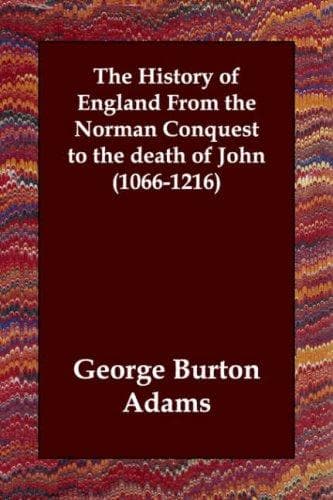
The History of England from the Norman Conquest to the Death of John (1066-1216)Adams, George Burton
History
The History of England from the Norman Conquest to the Death of John (1066-1216)
Adams, George Burton
Great Britain -- History -- Medieval period, 1066-1485
enjoyed so much, the result was, it is possible, not altogether
disagreeable to Robert himself. Some time later, when the pope
remonstrated with Henry on his conduct, and demanded the release of
Robert, the king's defence of his action was so complete that the pope
had no reply to make. Political expediency, the impossibility of
otherwise maintaining peace, was the burden of his answer, and this, if
not actual justice, must still be Henry's defence for his treatment of
his brother.
Henry returned to England in time for the Easter meeting of his court,
but the legalization of the compromise with Anselm was deferred to
Whitsuntide because the pope was about to hold a council in France, from
which some action affecting the question might be expected. At
Whitsuntide Anselm was ill, and another postponement was necessary. At
last, early in August, at a great council held in the king's palace in
London, the agreement was ratified. No formal statement of the terms of
this compromise has been given us by any contemporary authority, but such
accounts of it as we have, and such inferences as seem almost equally
direct, probably leave no important point unknown. Of all his claims,
Henry surrendered only the right of investiture with ring and staff.
These were spiritual symbols, typical of the bishop's relation to his
Church and of his pastoral duties. To the ecclesiastical mind the
conferring of them would seem more than any other part of the procedure
the actual granting of the religious office, though they had been used by
the kings merely as symbols of the fief granted. Some things would seem
to indicate that the forms of canonical election were more respected
after this compromise than they had been before, but this is true of
forms only, and if we may judge from a sentence in a letter to the pope,
in which Anselm tells him of the final settlement, this was not one of
the terms of the formal agreement, and William of Malmesbury says
distinctly that it was not. In all else the Church gave way to the king.
He made choice of the person to be elected, with such advice and counsel
as he chose to take, and his choice was final. He received the homage and
conferred investiture of the temporalities of the office of the new
prelate as his father and brother had done. Only when this was completed
to the king's satisfaction, and his permission to proceed received, was
the bishop elect consecrated to his spiritual office.
Public-domain text, read in full here on John Shaqi.
Reviews
Reviews
No reviews yet
Be the first to share your thoughts on this work.
Elsewhere in the archive
Join the Discussion
Join the discussion
Sign in to leave a comment or review.
Sign InorCreate an account