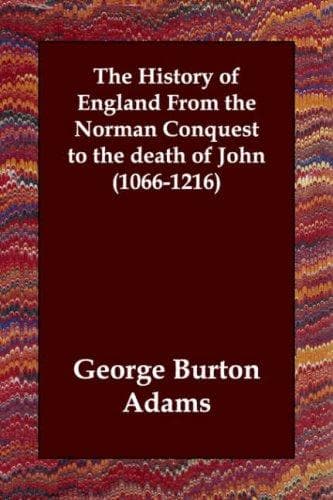
The History of England from the Norman Conquest to the Death of John (1066-1216)Adams, George Burton
History
The History of England from the Norman Conquest to the Death of John (1066-1216)
Adams, George Burton
Great Britain -- History -- Medieval period, 1066-1485
On November 4, 1112, an advantage fell to Henry which may have gone far
to secure him the remarkable terms of peace with which the war was
closed. He arrested Robert of Bellême, his constant enemy and the enemy
of all good men, "incomparable in all forms of evil since the beginning
of Christian days." He had come to meet the king at Bonneville, to bring
a message from Louis, thinking that Henry would be obliged to respect his
character as an envoy. Probably the king took the ground that by his
conduct Robert had forfeited all rights, and was to be treated
practically as a common outlaw. At any rate, he ordered his arrest and
trial. On three specific counts--that he had acted unjustly toward his
lord, that summoned three times to appear in court for trial he had not
come, and that as the king's viscount he had failed to render account of
the revenues he had collected--he was condemned and sentenced to
imprisonment. On Henry's return to England he was carried over and kept
in Wareham castle, where he was still alive in 1130. The Norman historian
Orderic records that this action of Henry's met with universal approval
and was greeted with general rejoicing.
During Lent of the next year, 1113, Henry made formal peace with both his
enemies, the king of France and the Count of Anjou. The peace with the
latter was first concluded. It was very possibly Fulk's refusal to
recognize Henry's overlordship of Maine that occasioned the war. To this
he now assented. He did homage for the county, and received investiture
of it from the hand of the king. He also promised the hand of his
daughter Matilda to Henry's son William. Henry, on his side, restored to
favour the Norman allies of Fulk. A few days later a treaty was made at
Gisors, with the king of France. Louis formally conceded to Henry the
overlordship of Bellême, which had not before depended upon the duchy of
Normandy, and that of Maine, and Britanny. In the case of Maine and of
Britanny this was the recognition of long-standing claims and of
accomplished facts, for Count Alan Fergant of Britanny, as well as Fulk
of Anjou, had already become the vassal of Henry, and had obtained the
hand of a natural daughter of the king for his son Conan, who in this
year became count. But the important lordship of Bellême was a new
cession. It was not yet in Henry's hands, nor had it been reckoned as a
part of Normandy, though the lords of Bellême had been also Norman
barons. Concessions such as these, forming with Normandy the area of many
a kingdom, were made by a king like Louis VI, only under the compulsion
of necessity. They mark the triumph of Henry's skill, of his vigorous
determination, and of his ready disregard of the legal rights of others,
if they would not conform to his ideas of proper conduct or fit into his
system of government. The occupation of Bellême required a campaign.
William Talvas, the son of Robert, while himself going to defend his
Public-domain text, read in full here on John Shaqi.
Reviews
Reviews
No reviews yet
Be the first to share your thoughts on this work.
Elsewhere in the archive
Join the Discussion
Join the discussion
Sign in to leave a comment or review.
Sign InorCreate an account