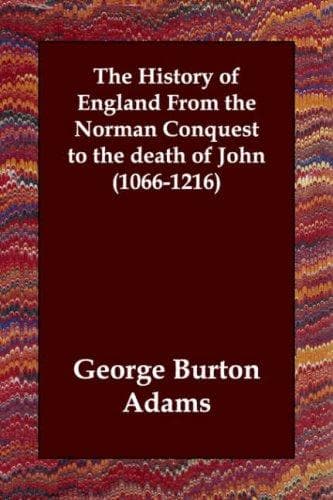
The History of England from the Norman Conquest to the Death of John (1066-1216)Adams, George Burton
History
The History of England from the Norman Conquest to the Death of John (1066-1216)
Adams, George Burton
Great Britain -- History -- Medieval period, 1066-1485
obedience which the most perfect secular absolutism would strive in vain
to secure. To have transformed the Church, which the emperor Henry III
had begun to reform in 1046, into that which survived the last year of
his dynasty, was a work of political genius as great as history records.
It was not before the demand of the pope in the matter of investiture
that the Norman absolute government of the Church went down. It fell
because the Norman theory of the national Church, closely under the
control of the state in every field of its activity, a part of the state
machinery, and a valuable assistant in the government of the nation, was
undermined and destroyed by a higher, and for that age a more useful,
conception. When the idea of the Church as a world-wide unity, more
closely bound to its theocratic head than to any temporal sovereign, and
with a mission and responsibility distinct from those of the state, took
possession of the body of the clergy, as it began to do in the reign of
Henry, it was impossible to maintain any longer the separateness of the
Norman Church. But the incorporation of the Norman and English churches
in the papal monarchy meant the slipping from the king's hands of power
in many individual cases, which the first two Norman kings had exercised
without question, and which even the third had continued to exercise.
The struggle of York to free itself from the promise of obedience to
Canterbury was only one of the many channels through which these new
ideas entered the kingdom. A new tide of monasticism had arisen on the
continent, which did not spend itself even with the northern borders of
England. The new orders and the new spirit found many abiding places in
the kingdom, and drew laity as well as clergy under their strong
influence. This was especially, though not alone, true of the Augustinian
canons, who possessed some fifty houses in England at the close of
Henry's reign, and in the later years of his life, of the Cistercians,
with whose founding an English saint, Stephen Harding, had had much to
do, and some of whose monasteries founded in this period, Tintern,
Rievaulx, Furness, and Fountains, are still familiar names, famous for
the beauty of their ruins. This new monasticism had been founded wholly
in the ideas of the new ecclesiastical monarchy, and was an expression of
them. The monasteries it created were organized, not as parts of the
state in which they were situated, but as parts of a great order,
international in its character, free from local control, and, though its
houses were situated in many lands, forming almost an independent state
under the direct sovereignty of the pope. The new monarchical papacy,
which emerged from the conflicts of this period, occupied Christendom
with its garrisons in these monastic houses, and every house was a source
from which its ruling ideas spread widely abroad.
Public-domain text, read in full here on John Shaqi.
Reviews
Reviews
No reviews yet
Be the first to share your thoughts on this work.
Elsewhere in the archive
Join the Discussion
Join the discussion
Sign in to leave a comment or review.
Sign InorCreate an account