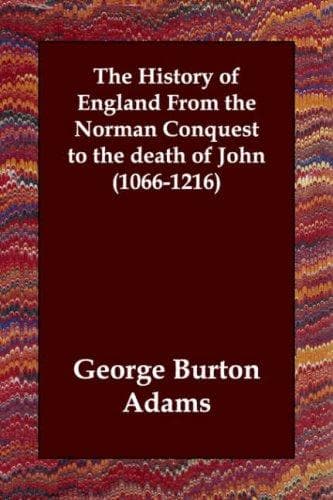
The History of England from the Norman Conquest to the Death of John (1066-1216)Adams, George Burton
History
The History of England from the Norman Conquest to the Death of John (1066-1216)
Adams, George Burton
Great Britain -- History -- Medieval period, 1066-1485
At this council King Louis of France, defeated in the field and now
without allies, appealed in person to the pope for the condemnation of
the king of England. He is said, by Orderic Vitalis who was probably
present at the council and heard him speak, to have recited the evil
deeds of Henry, from the imprisonment of Robert to the causes of the
present war. The pope himself was in a situation where he needed to
proceed with diplomatic caution, but he promised to seek an interview
with Henry and to endeavour to bring about peace. This interview took
place in November, at Gisors, and ended in the complete discomfiture of
the pope. Henry was now in a far stronger position than he had been at
the beginning of the year, and to the requests of Calixtus he returned
definite refusals or vague and general answers of which nothing was to be
made. The pope was even compelled to recognize the right of the English
king to decide when papal legates should be received in the kingdom.
Henry was, however, quite willing to make peace. He had won over Louis's
allies, defeated his attempt to gain the assistance of the pope, and
finally overcome the revolted Norman barons. He might reasonably have
demanded new advantages in addition to those which had been granted him
in the peace of 1113, but all that marks this treaty is the legal
recognition of his position in Normandy. Homage was done to Louis for
Normandy, not by Henry himself, for he was a king, but by his son William
for him. It is probable that at no previous date would this ceremony have
been acceptable, either to Louis or to Henry. On Louis's part it was not
merely a recognition of Henry's right to the duchy of Normandy, but it
was also a formal abandonment of William Clito, and an acceptance of
William, Henry's son, as the heir of his father. This act was accompanied
by a renewal of the homage of the Norman barons to William, whether made
necessary by the numerous rebellions of the past two years, or desirable
to perfect the legal chain, now that William had been recognized as heir
by his suzerain, a motive that would apply to all the barons.
Public-domain text, read in full here on John Shaqi.
Reviews
Reviews
No reviews yet
Be the first to share your thoughts on this work.
Elsewhere in the archive
Join the Discussion
Join the discussion
Sign in to leave a comment or review.
Sign InorCreate an account