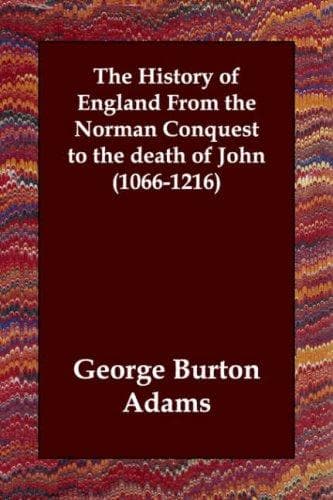
The History of England from the Norman Conquest to the Death of John (1066-1216)Adams, George Burton
History
The History of England from the Norman Conquest to the Death of John (1066-1216)
Adams, George Burton
Great Britain -- History -- Medieval period, 1066-1485
Against Fulk of Anjou Henry seems to have found his ally in the pope. The
marriage of William Clito with Sibyl, with all that it might carry with
it, was too threatening a danger to be allowed to stand, if in any way it
could be avoided. The convenient plea of relationship, convenient to be
remembered or forgotten according to the circumstances, was urged upon
the pope. The Clito and his bride were related in no nearer degree than
the tenth, according to the reckoning of the canon law, which prohibited
marriage between parties related in the seventh degree, and Henry's own
children, William in his earlier, and Matilda in her later marriage, with
the sister and brother of Sibyl, were equally subject to censure. But
this was a different case. Henry's arguments at Rome--Orderic tells us
that threats, prayers, and money were combined--were effective, and the
marriage was ordered dissolved. Excommunication and interdict were
necessary to enforce this decision; but at last, in the spring of 1125,
Fulk was obliged to yield, and William Clito began his wanderings once
more, followed everywhere by the "long arm" of his uncle.
At Easter time in 1125, probably a few days before the date of the papal
bull of interdict which compelled the dissolution of the marriage of
William and Sibyl, a papal legate, John of Crema, landed in England.
Possibly this departure from Henry's practice down to this time was a
part of the price which the papal decision cost. The legate made a
complete visitation of England, had a meeting with the king of Scots, and
presided at a council of the English Church held in September, where the
canons of Anselm were renewed in somewhat milder form. On his return to
Rome in October, he was accompanied by the Archbishops of Canterbury and
York, who went there about the still unsettled question of the obedience
of the latter. Not even now was this question settled on its merits, but
William of Corbeil made application, supported by the king, to be
appointed the standing papal legate in Britain. This request was granted,
and formed a precedent which was followed by successive popes and
archbishops. This appointment is usually considered a lowering of the
pretensions of the Archbishop of Canterbury, and an infringement of the
independence of the English Church, and to a considerable extent this is
true. Under a king as strong as Henry I, with an archbishop no stronger
than William of Corbeil, or, indeed, with one not exceptionally strong,
the papal authority gained very little from the arrangement. But it was a
perpetual opportunity; it was a recognition of papal right. Under it the
number of appeals to Rome increased; it marks in a legal way the advance
of papal authority and of a consciousness of unity in the Church since
the accession of the king, and it must have been so regarded at Rome. The
appointment gave to Canterbury at once undoubted supremacy over York, but
not on the old grounds, and that question was passed on to the future
Public-domain text, read in full here on John Shaqi.
Reviews
Reviews
No reviews yet
Be the first to share your thoughts on this work.
Elsewhere in the archive
Join the Discussion
Join the discussion
Sign in to leave a comment or review.
Sign InorCreate an account