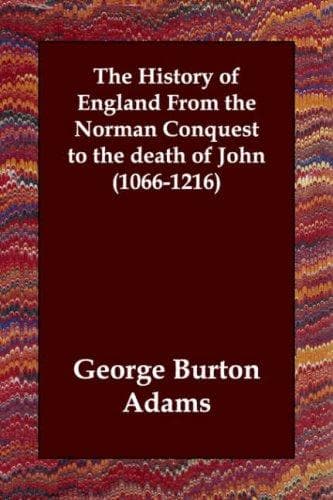
The History of England from the Norman Conquest to the Death of John (1066-1216)Adams, George Burton
History
The History of England from the Norman Conquest to the Death of John (1066-1216)
Adams, George Burton
Great Britain -- History -- Medieval period, 1066-1485
For this marriage no consent of English or Norman barons was asked, and
none was granted. Indeed, we are led to suspect that Henry considered it
unlikely that he could obtain consent, and deemed it wiser not to let his
plans be known until they were so far accomplished as to make opposition
useless. The natural rivalry and hostility between Normandy and Anjou had
been so many times passed on from father to son that such a marriage as
this could seem to the Norman barons nothing but a humiliation, and to
the Angevins hardly less than a triumph. The opposition, however, spent
itself in murmurs. The king was too strong. Probably also the political
advantages were too obvious to warrant any attempt to defeat the scheme.
Matilda herself is said to have been much opposed to the marriage, and
this we can easily believe. Geoffrey was more than ten years her junior,
and still a mere boy. She had but recently occupied the position of
highest rank in the world to which a woman could attain. She was
naturally of a proud and haughty spirit. We are told nothing of the
arguments which induced her to consent; but in this case again the
political advantage, the necessity of the marriage to the security of her
succession, must have been the controlling motive.
That these considerations were valid, that Henry was fully justified in
taking this step in the circumstances which had arisen, is open to no
question, if the matter is regarded as one of cold policy alone. To leave
Matilda's succession to the sole protection of the few barons of England,
who were likely to be faithful, however powerful they might be, would
have been madness under the new conditions. With William Clito likely to
be in possession of the resources of a strong feudal state, heartily
supported by the king of France, felt by the great mass of Norman barons
to be the rightful heir, and himself of considerable energy of character,
the odds would be decidedly in favour of his succession. The balance
could be restored only by bringing forward in support of Matilda's claim
a power equal to William's and certain not to abandon her cause. Henry
could feel that he had accomplished this by the marriage with Geoffrey,
and he had every reason to believe that he had converted at the same time
one of the probable enemies of his policy into its most interested
defender. Could he have foreseen the early death of William, he might
have had reason to hesitate and to question whether some other marriage
might not lead to a more sure success. That this plan failed in the end
is only a proof of Henry's foresight in providing, against an almost
inevitable failure, the best defence which ingenuity could devise.
Public-domain text, read in full here on John Shaqi.
Reviews
Reviews
No reviews yet
Be the first to share your thoughts on this work.
Elsewhere in the archive
Join the Discussion
Join the discussion
Sign in to leave a comment or review.
Sign InorCreate an account