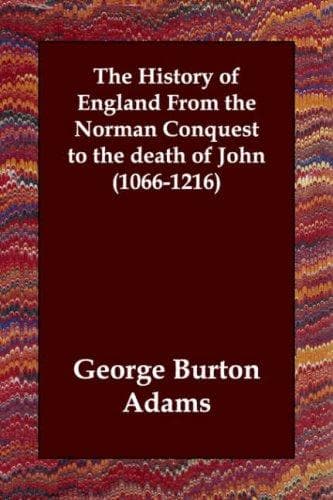
The History of England from the Norman Conquest to the Death of John (1066-1216)Adams, George Burton
History
The History of England from the Norman Conquest to the Death of John (1066-1216)
Adams, George Burton
Great Britain -- History -- Medieval period, 1066-1485
power had hardly been lessened by giving up the king's castles,--to which
he had been forced,--and it was not easy to attack him. On a later visit
of the young Henry to England, he obtained from him, and even from the
king of Scotland, to whom he had long been hostile, large additions to
his coveted principality in the west and north; but Stephen at once bid
higher, and for a grant including the same possessions and more he
abandoned his new allies. On Henry's final visit, in 1153, when the tide
was fairly turning in his favour, another well-timed treason secured the
earl his winnings and great promises for the future; but in this same
year he died, poisoned, as it was believed, by one whose lands he had
obtained. Out of the breaking up of England and the helplessness of her
rulers arose no independent feudalism. Higher titles and wider lands many
barons did gain, but the power of the king emerged in the end still
supreme, and the worst of the permanent evils of the feudal system, a
divided state, though deliberately sought and dangerously near, was at
last averted.
With the death of Pope Innocent II, in September, 1143, a new period
opened in the relation of the English Church and of the English king
towards the papacy. Innocent had been on the whole favourable to
Stephen's cause. His successor, Celestine II, was as favourable to Anjou,
but his papacy was so short that nothing was done except to withhold a
renewal of Henry of Winchester's commission as legate. Lucius II, who
succeeded in March, 1144, sent his own legate to England; but he was not
a partisan of either side, and seems even--perhaps by way of
compensation--to have taken steps towards creating an independent
archbishopric in the south-west in Henry's favour. His papacy again
lasted less than a year, and his successor, Eugenius III, whose reign
lasted almost to the end of Stephen's, was decidedly unfriendly. Henry of
Winchester was for a time suspended; and the king's candidate for the
archbishopric of York, William Fitz Herbert, afterwards St. William of
York,--whose position had long been in doubt, for though he had been
consecrated he had not received his pallium,--was deposed, and in his
place the Cistercian Abbot of Fountains, Henry Murdac, was consecrated by
the Cistercian pope. This was the beginning of open conflict. Henry
Murdac could not get possession of his see, and Archbishop Theobald was
refused permission to attend a council summoned by the pope at Reims for
March, 1148. He went secretly, crossing the channel in a fishing boat,
and was enthusiastically received by the pope. The Bishop of Winchester
was again suspended, and other bishops with him; several abbots were
deposed; and Gilbert Foliot, a decided partisan of Matilda's, was
designated Bishop of Hereford. The pope was with difficulty persuaded to
postpone the excommunication of Stephen himself, and steps were actually
taken to reopen before the Roman court the question of his right to the
throne.
Public-domain text, read in full here on John Shaqi.
Reviews
Reviews
No reviews yet
Be the first to share your thoughts on this work.
Elsewhere in the archive
Join the Discussion
Join the discussion
Sign in to leave a comment or review.
Sign InorCreate an account