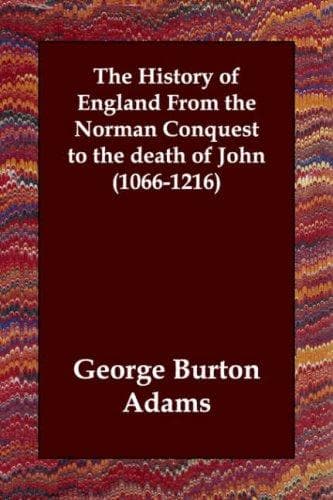
The History of England from the Norman Conquest to the Death of John (1066-1216)Adams, George Burton
History
The History of England from the Norman Conquest to the Death of John (1066-1216)
Adams, George Burton
Great Britain -- History -- Medieval period, 1066-1485
From Wallingford Henry marched north through central England, where towns
and castles one after another fell into his hands. From Wallingford also,
Eustace withdrew from his father, greatly angered by the truce which had
been made, and went off to the east on an expedition of his own which
looks much like a plundering raid. Rashly he laid waste the lands of St.
Edmund, who was well known to be a fierce protector of his own and to
have no hesitation at striking even a royal robber. Punishment quickly
followed the offence. Within a week Eustace was smitten with madness and
died on August 17, a new and terrible warning of the fate of the
sacrilegious. This death changed the whole outlook for the future.
Stephen had no more interest in continuing the war than to protect
himself. His wife had now been dead for more than a year. His next son,
William, had never looked forward to the crown, and had never been
prominent in the struggle. He had been lately married to the heiress of
the Earl of Surrey, and if he could be secured in the quiet and
undisputed possession of this inheritance and of the lands which his
father had granted him, and of the still broader lands in Normandy and
England which had belonged to Stephen before he seized the crown, then
the advantage might very well seem to the king, near the close of his
stormy life, greater than any to be gained from the desperate struggle
for the throne. The Archbishop of Canterbury, who had by some means
returned to England, proposed peace, and undertook negotiations between
the king and the duke, supported by Henry of Winchester. Henry of Anjou
could well afford to wait. The delay before he could in this way obtain
the crown would probably not be very long and would be amply compensated
by a peaceful and undisputed succession, while in the meantime he could
give himself entirely to the mission which, since he had landed in
England, he had loudly proclaimed as his of putting an end to plundering
and oppression. On November 6 the rivals met at Winchester to make peace,
and the terms of their agreement were recited in a great council of the
kingdom, probably the first which was in any sense a council of the whole
kingdom that had met in nearly or quite fifteen years. First, the king
formally recognized before the assembly the hereditary right of Henry to
the kingdom of England. Then the duke formally agreed that Stephen should
hold the throne so long as he should live; and king, and bishops, and
barons bound themselves with an oath that on Stephen's death Henry should
succeed peacefully and without any contradiction. It was also agreed
under oath, that all possessions which had been seized by force should be
restored to their rightful owners, and that all castles which had been
erected since the death of Henry I should be destroyed, and the number of
these was noted at the time as 1115, though a more credible statement
gives the number as 375. The treaty between the two which had no doubt
Public-domain text, read in full here on John Shaqi.
Reviews
Reviews
No reviews yet
Be the first to share your thoughts on this work.
Elsewhere in the archive
Join the Discussion
Join the discussion
Sign in to leave a comment or review.
Sign InorCreate an account