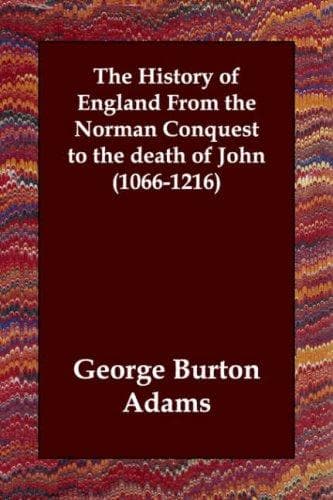
The History of England from the Norman Conquest to the Death of John (1066-1216)Adams, George Burton
History
The History of England from the Norman Conquest to the Death of John (1066-1216)
Adams, George Burton
Great Britain -- History -- Medieval period, 1066-1485
In the gifts of statesmanship and the abilities which make a great ruler
Henry seemed to his own time above the average of kings, and certainly
this is true in comparison with the king who was his rival during so much
of his reign, Louis VII of France. Posterity has also agreed to call him
one of the greatest, some have been inclined to say the greatest, of
English sovereigns. The first heavy task that fell to him, the
establishment of peace and strong government in England, he fully
achieved; and this work was thankfully celebrated by his contemporaries.
All his acts give us the impression of mental and physical power, and no
recasting of balances is ever likely to destroy the impression of great
abilities occupied with great tasks, but we need perhaps to be reminded
that to his age his position made him great, and that even upon us its
effect is magnifying. Except in the pacification of England he won no
signal success, and the schemes to which he gave his best days ended in
failure or barely escaped it. It is indeed impossible to say that in his
long reign he had before him any definite or clear policy, except to be a
strong king and to assert vigorously every right to which he believed he
could lay claim. The opportunity which his continental dominions offered
him he seems never to have understood, or at least not as it would have
been understood by a modern sovereign or by a Philip Augustus. It is
altogether probable that the successful welding together of the various
states which he held by one title or another into a consolidated monarchy
would have been impossible; but that the history of his reign gives no
clear evidence that he saw the vision of such a result, or studied the
means to accomplish it, forces us to classify Henry, in one important
respect at least, with the great kings of the past and not with those of
the coming age. In truth he was a feudal king. Notwithstanding the severe
blows which he dealt feudalism in its relation to the government of the
state, it was still feudalism as a system of life, as a source of ideals
and a guide to conduct, which ruled him to the end. He had been brought
up entirely in a feudal atmosphere, and he never freed himself from it.
He was determined to be a strong king, to be obeyed, and to allow no
infringement of his own rights,--indeed, to push them to the farthest
limit possible,--but there seems never to have been any conflict in his
mind between his duties as suzerain or vassal and any newer conception of
his position and its opportunities.
Public-domain text, read in full here on John Shaqi.
Reviews
Reviews
No reviews yet
Be the first to share your thoughts on this work.
Elsewhere in the archive
Join the Discussion
Join the discussion
Sign in to leave a comment or review.
Sign InorCreate an account