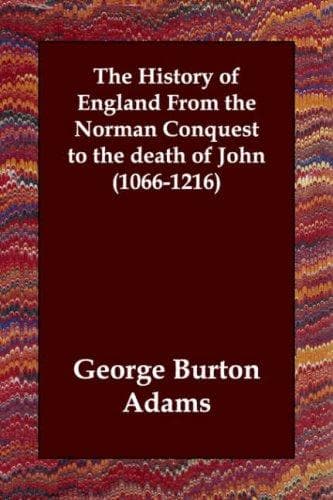
The History of England from the Norman Conquest to the Death of John (1066-1216)Adams, George Burton
History
The History of England from the Norman Conquest to the Death of John (1066-1216)
Adams, George Burton
Great Britain -- History -- Medieval period, 1066-1485
The first work before the young king would be to select those who should
aid him in the task of government in the chief offices of the state. He
probably already had a number of these men in mind from his knowledge of
England and of the leaders of his mother's party. In the peace with
Stephen, Richard de Lucy had been put in charge of the Tower and of
Windsor castle. He now seems to have been made justiciar, perhaps the
first of Henry's appointments, as he alone signs the coronation charter
though without official designation. Within a few days, however, Robert
de Beaumont, Earl of Leicester, was apparently given office with the same
title, and together they fill this position for many years, Robert
completing in it the century and more of faithful service which his
family had rendered to every successive king. The family of Roger of
Salisbury was also restored to the important branch of the service which
it had done so much to create, in the person of Nigel, Bishop of Ely, who
was given charge of the exchequer. The most important appointment in its
influence on the reign was that to the chancellorship. Archbishop
Theobald, who was probably one of Henry's most intimate counsellors, had
a candidate in whose favour he could speak in the strongest terms and
whose services in the past the king would gratefully recall. This was the
young Thomas Becket, who had done so much to prevent the coronation of
Eustace.
Immediately after his coronation, at Christmas time, Henry held at
Bermondsey the first of the great councils of his reign. Here the whole
state of the kingdom was discussed, and it was determined to proceed with
the expulsion of Stephen's mercenaries, and with the destruction of the
unlawful castles. The first of these undertakings gave no trouble, and
William of Ypres disappears from English history. The second, especially
with what went with it,--the resumption of Stephen's grants to great as
well as small,--was a more difficult and longer process. To begin it in
the proper way, the king himself set out early in 1155 for the north. For
some reason he did not think it wise at this time to run the risk of a
quarrel with Hugh Bigod, and it was probably on this journey at
Northampton that he gave him a charter creating him Earl of Norfolk, the
title which he had obtained from Stephen. The expedition was especially
directed against William of Aumale, Stephen's Earl of Yorkshire, and he
was compelled to surrender a part of his spoils including the strong
castle of Scarborough. William Peverel of the Peak also, who was accused
of poisoning the Earl of Chester, and who knew that there were other
reasons of condemnation against him, took refuge in a monastery, making
profession as a monk when he heard of Henry's approach, and finally fled
to the continent and abandoned everything to the king. Some time after
this, but probably during the same year, another of Stephen's earls,
William of Arundel or Sussex, obtained a charter of confirmation of the
Public-domain text, read in full here on John Shaqi.
Reviews
Reviews
No reviews yet
Be the first to share your thoughts on this work.
Elsewhere in the archive
Join the Discussion
Join the discussion
Sign in to leave a comment or review.
Sign InorCreate an account