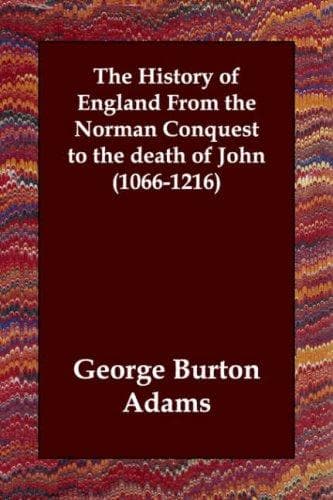
The History of England from the Norman Conquest to the Death of John (1066-1216)Adams, George Burton
History
The History of England from the Norman Conquest to the Death of John (1066-1216)
Adams, George Burton
Great Britain -- History -- Medieval period, 1066-1485
Thomas had come to the chancellorship at the age of thirty-seven. He had
been a student, attached to the household of Archbishop Theobald, and he
must long have looked forward to promotion in the Church as the natural
field of his ambition, and in this he had just taken the first step in
his appointment to the rich archdeaconry of Canterbury by his patron. As
chancellor, however, he seems to have faced entirely about. He threw
himself into the elegant and luxurious life of the court with an
abandon and delight which, we are tempted to believe, reveal his
natural bent. The family of a wealthy burgher of London in the last part
of the reign of Henry I may easily have been a better school of manners
and taste than the court of Anjou. Certainly in refinement, and in the
order and elegance of his household as it is described, the chancellor
surpassed the king. Provided with an ample income both from benefices
which he held in the Church and from the perquisites of his office, he
indulged in a profusion of expenditure and display which the king
probably did not care for and certainly did not equal, and collected
about himself such a company of clerks and laymen as made his household a
better place for the training of the children of the nobles than the
king's. In the king's service he spent his money with as lavish a hand as
for himself, in his embassy to the French court or in the war against
Toulouse. He had the skill to avoid the envy of either king or courtier,
and no scandal or hint of vice was breathed against him. The way to the
highest which one could hope for in the service of the state seemed open
before him, and he felt himself peculiarly adapted to enjoy and render
useful such a career. One cannot help speculating on the interesting but
hopeless problem of what the result would have been if Becket had
remained in the line of secular promotion and the primacy had gone to the
next most likely candidate, Gilbert Foliot, whose type of mind would have
led him to sympathize more naturally with the king's views and purposes
in the questions that were so soon to arise between Church and State in
England.
Public-domain text, read in full here on John Shaqi.
Reviews
Reviews
No reviews yet
Be the first to share your thoughts on this work.
Elsewhere in the archive
Join the Discussion
Join the discussion
Sign in to leave a comment or review.
Sign InorCreate an account