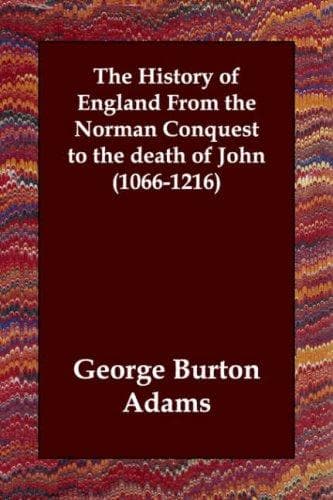
The History of England from the Norman Conquest to the Death of John (1066-1216)Adams, George Burton
History
The History of England from the Norman Conquest to the Death of John (1066-1216)
Adams, George Burton
Great Britain -- History -- Medieval period, 1066-1485
The martyrdom of Thomas Becket served his cause better than his
continuance in life could have done. Even if his murderers foolishly
thought to serve the king by their deed, Henry himself was under no
delusion as to its effect. He was thunderstruck at the news, and, in a
frenzy of horror which was no doubt genuine, as well as to mark his
repudiation of all share in the deed, he fasted and shut himself from
communication with the court for days. But the public opinion of Europe
would not acquit Henry of the guilt. Letters poured in upon the pope
denouncing him and demanding his punishment. The interdict of his Norman
dominions which had been threatened was proclaimed by the Archbishop of
Sens, but suspended again by an appeal to the pope. Events moved slowly
in the twelfth century, and before the pope could take any active steps
in the case, an embassy which left Normandy almost immediately had time
to reach him and to promise on the part of the king his complete
submission to whatever the pope should decree after examination of the
facts. Immediate punishment of any severity was thus avoided, and the
embassy of two cardinals to Normandy which the pope announced could act
only after some delay.
In the meanwhile in England Thomas the archbishop was being rapidly
transformed into Thomas the saint. Miracles were reported almost at once,
and the legend of his saintship took its rise and began to throw a new
light over the events of his earlier life. The preparation of his body
for the grave had revealed his secret asceticism,--the hair garments next
his skin and long unchanged. The people believed him to be a true martyr,
and his popular canonization preceded by some time the official, though
this followed with unusual quickness even for the middle ages. It was
pronounced by the pope in whose reign he had died on February 21, 1173.
For generations he remained the favourite saint of England, and his
popularity in foreign lands is surprising, though it must be remembered
that he was a great and most conspicuous martyr of the official Church,
of the new Hildebrandine Church, of the spirit and ideas which were by
that date everywhere in command.
Public-domain text, read in full here on John Shaqi.
Reviews
Reviews
No reviews yet
Be the first to share your thoughts on this work.
Elsewhere in the archive
Join the Discussion
Join the discussion
Sign in to leave a comment or review.
Sign InorCreate an account