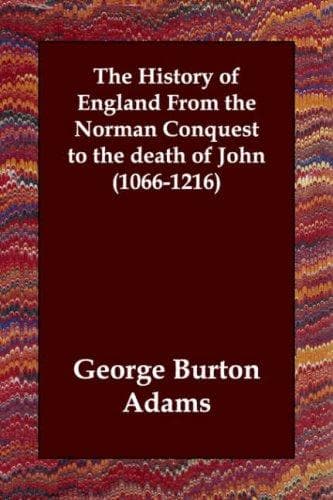
The History of England from the Norman Conquest to the Death of John (1066-1216)Adams, George Burton
History
The History of England from the Norman Conquest to the Death of John (1066-1216)
Adams, George Burton
Great Britain -- History -- Medieval period, 1066-1485
silver coins tumbled in a heap on the floor from which all might help
themselves. But these poems record the ideal, and probably no other age
saw more men, from kings down to simple knights, who tried to pattern
themselves on this model and to look on wealth as an exhaustless store of
things to be given away. But in the mind of kings who reigned in a world
more real than the romances of chivalry, this duty had always to contend
with natural ambition and with their responsibility for the welfare of
the lands they ruled. The last half of the twelfth century saw these
considerations grow rapidly stronger. The age that formed and applauded
the young Henry also gave birth to Philip Augustus.
The marriage with Eleanor added to the strange mixture of blood in the
Norman-Angevin house a new and warmer strain. It showed itself, careless,
luxurious, self-indulgent, restless at any control, in her sons. But the
marriage had also its effect on the husband and father. It gave a strong
impetus to the conquest, which had already begun, of the colder and
slower north by the ideals of duty and manners which had blossomed out
into a veritable theory of life in the more tropical south. Henry could
not keep himself from the spell of these influences, though they never
controlled him as they did his children. It seems impossible to doubt,
however, that he really believed it to be his duly to give his sons the
position that belonged to them as princes, where they could form courts
of their own, surrounded by their barons and knights, and display the
virtues which belonged to their station. They had a rightful claim to
this, which the ruling idea of conduct befitting a king would not allow
him to deny. The story of Henry's waiting on his son at table after his
coronation "as seneschal" and the reply of the young king to those who
spoke of the honour done him, that it was a proper thing for one who was
only the son of a count to wait on the son of a king, is significant of
deeper things than mere manners. But, though he might be under the spell
of these ideals, to partition his kingdom in very truth, to divest
himself of power, to make his sons actually independent in the provinces
which he gave them, was impossible to him. The power of his empire he
could not break up. The real control of the whole, and even the greater
part of the revenues, must remain in his hands. The conflict of ideas in
his mind, when he tried to be true to them all in practice, led
inevitably to a like conflict of facts and of physical force.
Public-domain text, read in full here on John Shaqi.
Reviews
Reviews
No reviews yet
Be the first to share your thoughts on this work.
Elsewhere in the archive
Join the Discussion
Join the discussion
Sign in to leave a comment or review.
Sign InorCreate an account