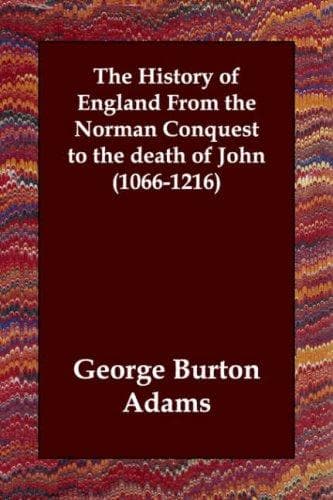
The History of England from the Norman Conquest to the Death of John (1066-1216)Adams, George Burton
History
The History of England from the Norman Conquest to the Death of John (1066-1216)
Adams, George Burton
Great Britain -- History -- Medieval period, 1066-1485
In 1175 the two kings crossed together to England, though the young king,
who was still listening to the suggestions of France and who professed to
be suspicious of his father's intentions, was with some difficulty
persuaded to go. He also seems to have been troubled by his father's
refusal to receive his homage at the same time with his brothers'; at any
rate when he finally joined the king on April 1, he begged with tears for
permission to do homage as a mark of his father's love, and Henry
consented. At the end of the first week in May they crossed the channel
for a longer stay in England than usual, of more than two years, and one
that was crowded with work both political and administrative. The king's
first act marks the new era of peace with the Church, his attendance at a
council of the English Church held at London by Archbishop Richard of
Canterbury; and his second was a pilgrimage with his son to the tomb of
St. Thomas. Soon after the work of filling long-vacant sees and abbacies
was begun. At the same time matters growing out of the insurrection
received attention. William, Earl of Gloucester, was compelled to give up
Bristol castle which he had kept until now. Those who had been opposed to
the king were forbidden to come to court unless ordered to do so by him.
The bearing of arms in England was prohibited by a temporary regulation,
and the affairs of Wales were considered in a great council at
Gloucester.
One of the few acts of severity which Henry permitted himself after the
rebellion seems to have struck friend and foe alike, and suggests a
situation of much interest to us which would be likely to give us a good
deal of insight into the methods and ideas of the time if we understood
it in detail. Unfortunately we are left with only a bare statement of the
facts, with no explanation of the circumstances or of the motives of the
king. Apparently at the Whitsuntide court held at Reading on the first
day of June, Henry ordered the beginning of a series of prosecutions
against high and low, churchmen and laymen alike, for violations of the
forest laws committed during the war. At Nottingham, at the beginning of
August, these prosecutions were carried further, and there the incident
occurred which gives peculiar interest to the proceedings. Richard of
Lucy, the king's faithful minister and justiciar, produced before the
king his own writ ordering him to proclaim the suspension of the laws in
regard to hunting and fishing during the war. This Richard testified that
he had done as he was commanded, and that the defendants trusting to this
writ had fearlessly taken the king's venison. We are simply told in
addition that this writ and Richard's testimony had no effect against the
king's will. It is impossible to doubt that this incident occurred or
that such a writ had been sent to the justiciar, but it seems certain
that some essential detail of the situation is omitted. To guess what it
Public-domain text, read in full here on John Shaqi.
Reviews
Reviews
No reviews yet
Be the first to share your thoughts on this work.
Elsewhere in the archive
Join the Discussion
Join the discussion
Sign in to leave a comment or review.
Sign InorCreate an account