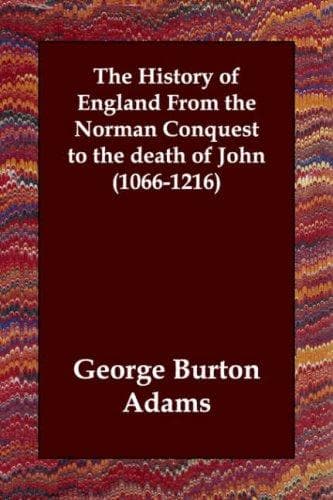
The History of England from the Norman Conquest to the Death of John (1066-1216)Adams, George Burton
History
The History of England from the Norman Conquest to the Death of John (1066-1216)
Adams, George Burton
Great Britain -- History -- Medieval period, 1066-1485
The death of young Henry led at once to annoying questions raised by
Philip of France. His sister Margaret was now a widow without children,
and he had some right to demand that the lands which had been ceded by
France to Normandy as her marriage portion should be restored. These were
the Norman Vexin and the important frontier fortress of Gisors. In the
troublous times of 1151 Count Geoffrey might have felt justified in
surrendering so important a part of Norman territory and defences to the
king of France in order to secure the possession of the rest to his son,
but times were now changed for that son, and he could not consent to open
up the road into the heart of Normandy to his possible enemies. He
replied to Philip that the cession of the Vexin had been final and that
there could be no question of its return. Philip was not easily
satisfied, and there was much negotiation before a treaty on the subject
was finally made at the beginning of December, 1183. At a conference near
Gisors Henry did homage to Philip for all his French possessions, a
liberal pension was accepted for Margaret in lieu of her dower lands, and
the king of France recognized the permanence of the cession to Normandy
on the condition that Gisors should go to one of the sons of Henry on his
marriage with Adela which was once more promised. This marriage in the
end never took place, but the Vexin remained a Norman possession.
The year 1184 was a repetition in a series of minor details, family
quarrels, foreign negotiations, problems of government, and acts of
legislation, of many earlier years of the life of Henry. After Christmas,
1183, angered apparently by a new refusal of Richard to give up Aquitaine
to John, or to allow any provision to be made for him in the duchy, Henry
gave John an army and permission to make war on his brother to force from
him what he could. Geoffrey joined in to aid John, or for his own
satisfaction, and together they laid waste parts of Richard's lands. He
replied in kind with an invasion of Britanny, and finally Henry had to
interfere and order all his sons over to England that he might reconcile
them. In the spring of the year he found it necessary to try to make
peace again between the king of France and the Count of Flanders. The
agreement which he had arranged in 1182 had not really settled the
difficulties that had arisen. The question now chiefly concerned the
lands of Vermandois, Amiens, and Valois, the inheritance which the
Countess of Flanders had brought to her husband. She had died just before
the conclusion of the peace in 1182, without heirs, and it had been then
agreed that the Count should retain possession of the lands during his
life, recognizing certain rights of the king of France. Now he had
contracted a second marriage in the evident hope of passing on his claims
to children of his own. Philip's declaration that this marriage should
make no difference in the disposition of these lands which were to prove
Public-domain text, read in full here on John Shaqi.
Reviews
Reviews
No reviews yet
Be the first to share your thoughts on this work.
Elsewhere in the archive
Join the Discussion
Join the discussion
Sign in to leave a comment or review.
Sign InorCreate an account