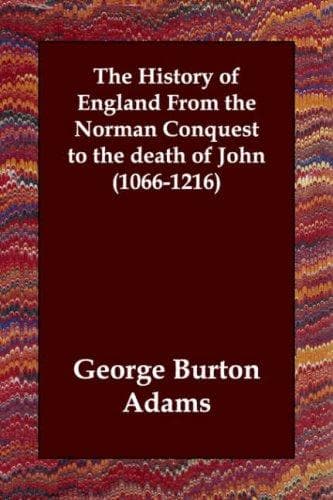
The History of England from the Norman Conquest to the Death of John (1066-1216)Adams, George Burton
History
The History of England from the Norman Conquest to the Death of John (1066-1216)
Adams, George Burton
Great Britain -- History -- Medieval period, 1066-1485
Political events had not waited for the reformation of the Church, and
long before these reforms were completed, England had become a thoroughly
settled state under the new king. The beginning of the year 1070 is a
turning-point in the reign of William. The necessity for fighting was not
over, but from this date onwards there was no more fighting for the
actual possession of the land. The irreconcilables had still to be dealt
with; in one small locality they retained even yet some resisting power;
the danger of foreign invasion had again to be met: but not for one
moment after William's return from the devastation of the north and west
was there even the remotest possibility of undoing the Conquest.
The Danes had withdrawn from the region of the Humber, but they had not
left the country. In the Isle of Ely, then more nearly an actual island
than in modern times, was a bit of unsubdued England, and there they
landed for a time. In this position, surrounded by fens and interlacing
rivers, accessible at only a few points, occurred the last resistance
which gave the Normans any trouble. The rich mythology which found its
starting-point in this resistance, and especially in its leader,
Hereward, we no longer mistake for history; but we should not forget that
it embodies the popular attitude towards those who stubbornly resisted
the Norman, as it was handed on by tradition, and that it reveals almost
pathetically the dearth of heroic material in an age which should have
produced it in abundance. Hereward was a tenant in a small way of the
abbey of Peterborough. What led him into such a determined revolt we do
not know, unless he was among those who were induced to join the Danes
after their arrival, in the belief that their invasion would be
successful. Nor do we know what collected in the Isle of Ely a band of
men whom the Peterborough chronicler was probably not wrong, from any
point of view, in calling outlaws. A force of desperate men could hope to
maintain themselves for some time in the Isle of Ely; they could not hope
for anything more than this. The coming of the Danes added little real
strength, though the country about believed for the moment, as it had
done north of the Humber, that the tide had turned. The first act of the
allies was the plunder and destruction of the abbey and town of
Peterborough shortly after the meeting of the council of Windsor. The
English abbot Brand had died the previous autumn, and William had
appointed in his place a Norman, Turold, distinguished as a good fighter
and a hard ruler. These qualities had led the king to select him for this
special post, and the plundering of the abbey, so far as it was not mere
marauding, looks like an answering act of spite. The Danes seem to have
been disposed at first to hold Peterborough, but Turold must have brought
them proposals of peace from William, which induced them to withdraw at
last from England with the secure possession of their plunder.
Public-domain text, read in full here on John Shaqi.
Reviews
Reviews
No reviews yet
Be the first to share your thoughts on this work.
Elsewhere in the archive
Join the Discussion
Join the discussion
Sign in to leave a comment or review.
Sign InorCreate an account