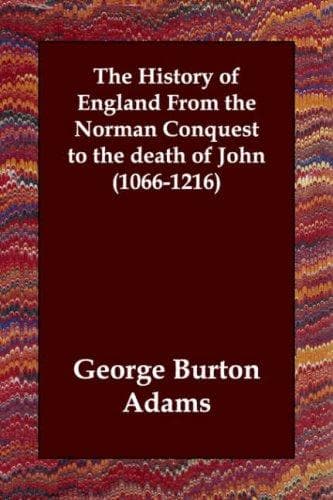
The History of England from the Norman Conquest to the Death of John (1066-1216)Adams, George Burton
History
The History of England from the Norman Conquest to the Death of John (1066-1216)
Adams, George Burton
Great Britain -- History -- Medieval period, 1066-1485
Hereward and his men accomplished nothing more that year, but others
gradually gathered in to them, including some men of note. Edwin and
Morcar had once more changed sides, or had fled from William's court to
escape some danger there. Edwin had been killed in trying to make his way
through to Scotland, but Morcar had joined the refugees in Ely. Bishop
Ethelwin of Durham was also there, and a northern thane, Siward Barn. In
1074 William advanced in person against the "camp of refuge." A fleet was
sent to blockade one side while the army attacked from the other. It was
found necessary to build a long causeway for the approach of the army and
around this work the fiercest fighting occurred; but its building could
not be stopped, and just as it was finished the defenders of the Isle
surrendered. The leaders were imprisoned, Morcar in Normandy for the rest
of William's reign. The common men were mutilated and released. Hereward
escaped to sea, but probably afterwards submitted to William and received
his favour. Edric the Wild, who had long remained unsubdued on the Welsh
borders, had also yielded before the surrender of the Isle of Ely, and
the last resistance that can be called in any sense organized was at an
end.
The comparatively easy pacification of the land, the early submission to
their fate of so strong a nation, was in no small degree aided by the
completeness with which the country was already occupied by Norman
colonies, if we may call them so. Probably before the surrender of Ely
every important town was under the immediate supervision of some Norman
baron, with a force of his own. In all the strategically important places
fortified posts had been built and regular garrisons stationed. Even the
country districts had to a large extent been occupied in a similar way.
It is hardly probable that as late as 1072 any considerable area in
England had escaped extensive confiscations. Everywhere the Norman had
appeared to take possession of his fief, to establish new tenants, or to
bring the old ones into new relations with himself, to arrange for the
administration of his manors, and to leave behind him the agents who were
responsible to himself for the good conduct of affairs. If he made but
little change in the economic organization of his property, and disturbed
the labouring class but slightly or not at all, he would give to a wide
district a vivid impression of the strength of the new order and of the
hopelessness of any resistance.
Public-domain text, read in full here on John Shaqi.
Reviews
Reviews
No reviews yet
Be the first to share your thoughts on this work.
Elsewhere in the archive
Join the Discussion
Join the discussion
Sign in to leave a comment or review.
Sign InorCreate an account