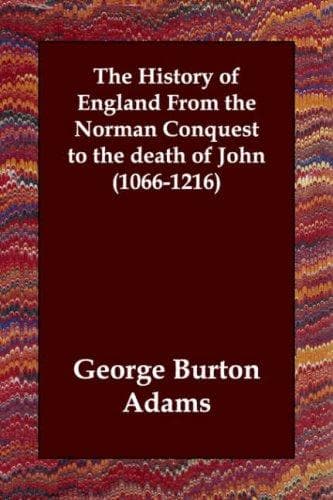
The History of England from the Norman Conquest to the Death of John (1066-1216)Adams, George Burton
History
The History of England from the Norman Conquest to the Death of John (1066-1216)
Adams, George Burton
Great Britain -- History -- Medieval period, 1066-1485
Already Norman families, who were to make so much of the history of the
coming centuries, were rooted in the land. Montfort and Mortimer; Percy,
Beauchamp, and Mowbray; Ferrets and Lacy; Beaumont, Mandeville, and
Grantmesnil; Clare, Bigod, and Bohun; and many others of equal or nearly
equal name. All these were as yet of no higher than baronial rank, but if
we could trust the chroniclers, we should be able to make out in addition
a considerable list of earldoms which William had established by this
date or soon afterwards, in many parts of England, and in these were
other great names. According to this evidence, his two half brothers, the
children of his mother by her marriage with Herlwin de Conteville, had
been most richly provided for: Odo, Bishop of Bayeux, as Earl of Kent,
and Robert, Count of Mortain, with a princely domain in the south-west as
Earl of Cornwall. One of the earliest to be made an earl was his old
friend and the son of his guardian, William Fitz Osbern, who had been
created Earl of Hereford; he was now dead and was succeeded by his son
Roger, soon very justly to lose title and land. Shrewsbury was held by
Roger of Montgomery; Chester by Hugh of Avranches, the second earl;
Surrey by William of Warenne; Berkshire by Walter Giffard. Alan Rufus of
Britanny was Earl of Richmondshire; Odo of Champagne, Earl of Holderness;
and Ralph of Guader, who was to share in the downfall of Roger Fitz
Osbern, Earl of Norfolk. One Englishman, who with much less justice was
to be involved in the fate which rightly befell these two Norman earls,
was also earl at this time, Watheof, who had lately succeeded Gospatric
in the troubled earldom of Northumberland, and who also held the earldoms
of Northampton and Huntingdon. These men certainly held important
lordships in the districts named, but whether so many earldoms, in form
and law, had really been established by the Conqueror at this date, or
were established by him at any later time, is exceedingly doubtful. The
evidence of the chroniclers is easily shown to be untrustworthy in the
matter of titles, and the more satisfactory evidence which we obtain from
charters and the Domesday Book does not justify this extensive list.
But the historian does not find it possible to decide with confidence in
every individual case. Of the earldoms of this list it is nearly certain
that we must drop out those of Cornwall, Holderness, Surrey, Berkshire,
and Richmond, and almost or quite certain that we may allow to stand
those of Waltheof and William Fitz Osbern, of Kent, Chester, and
Shrewsbury.
Public-domain text, read in full here on John Shaqi.
Reviews
Reviews
No reviews yet
Be the first to share your thoughts on this work.
Elsewhere in the archive
Join the Discussion
Join the discussion
Sign in to leave a comment or review.
Sign InorCreate an account