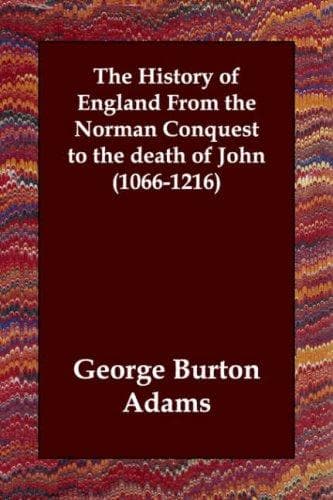
The History of England from the Norman Conquest to the Death of John (1066-1216)Adams, George Burton
History
The History of England from the Norman Conquest to the Death of John (1066-1216)
Adams, George Burton
Great Britain -- History -- Medieval period, 1066-1485
of its holder in the time of King Edward and at the time of the inquiry;
the number of hides it contained; the number of ploughs employed in the
cultivation of the lord's domain land, and the number so used on the
lands held by the lord's men,--a rough way of determining the amount of
land under cultivation. Then the population of the manor was to be given
in classes: freemen and sokemen; villeins, cotters, and serfs; the amount
of forest and meadow; the number of pastures, mills, and fish-ponds; and
what the value of the manor was in the time of King Edward, at the date
of its grant by King William, and at the time of the inquiry. In some
cases evidently the jurors entered into such details of the live stock
maintained by the manor as to justify the indignant words of the Saxon
chronicler, that not "an ox nor a cow nor a swine was left that was not
set down in his writing."
The object of all this is plain enough. It was an assessment of the
property of the kingdom for purposes of taxation. The king wished to find
out, as indeed we are told in what may be considered a copy or an
abstract of the original writ directing the commissioners as to their
inquiries, whether he could get more from the kingdom in taxes than he
was then getting. But the record of this inquest has served far different
purposes in later times. It is a storehouse of information on many sides
of history, personal, family, geographical, and especially economic. It
tells us much also of institutions, but less than we could wish, and less
than it would have told us if its purpose had been less narrowly
practical. Indeed, this limiting of the record to a single definite
purpose, which was the controlling interest in making it, renders the
information which it gives us upon all the subjects in which we are now
most interested fragmentary and extremely tantalizing, and forces us to
use it with great caution. It remains, however, even with this
qualification, a most interesting collection of facts, unique in all the
Middle Ages, and a monument to the practical genius of the monarch who
devised it.
On August 1 of the same year in which the survey was completed, in a
great assembly on Salisbury Plain, an oath of allegiance to the king was
taken by all the land-holding men of England, no matter of whom they
held. This has been represented as an act of new legislation of great
institutional importance, but the view cannot be maintained. It is
impossible to suppose that all land-owners were present or that such an
oath had not been generally taken before; and the Salisbury instance was
either a renewal of it such as was occasionally demanded by kings of this
age, or possibly an emphatic enforcement of the principle in cases where
it had been neglected or overlooked, now perhaps brought to light by the
survey.
Public-domain text, read in full here on John Shaqi.
Reviews
Reviews
No reviews yet
Be the first to share your thoughts on this work.
Elsewhere in the archive
Join the Discussion
Join the discussion
Sign in to leave a comment or review.
Sign InorCreate an account