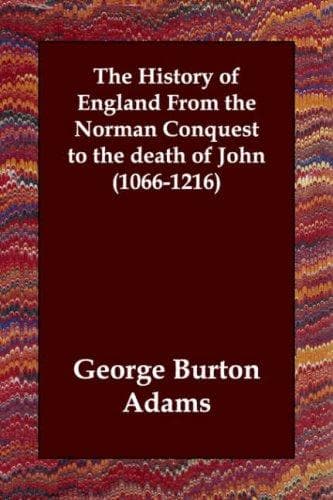
The History of England from the Norman Conquest to the Death of John (1066-1216)Adams, George Burton
History
The History of England from the Norman Conquest to the Death of John (1066-1216)
Adams, George Burton
Great Britain -- History -- Medieval period, 1066-1485
William, the second son of the Conqueror, followed with no filial
compunction his father's command that he should leave his death-bed and
cross the channel at once to secure the kingdom of England. At the port
of embarkation he learned that his father had died, but he did not turn
back. Probably the news only hastened his journey, if this were possible.
In England he went first to Winchester to get possession of his father's
great treasure, and then to Canterbury with his letter to Lanfranc.
Nowhere is there any sign of opposition to his succession, or of any
movement in favour of Robert, or on Robert's part, at this moment. If the
archbishop had any doubts, as a man of his good judgment might well have
had, knowing the new king from his boyhood, they were soon quieted or he
resolved to put them aside. He had, indeed, no alternative. There is
nothing to indicate that the letter of his dying master allowed him any
choice, nor was there any possible candidate who gave promise of a better
reign, for Lanfranc must have known Robert as well as he knew William.
Together they went up to London, and on September 26, 1087, hardly more
than two weeks after he left his father's bedside, William was crowned
king by Lanfranc. The archbishop took of him the customary oath to rule
justly and to defend the peace and liberty of the Church, exacting a
special promise always to be guided by his advice; but there is no
evidence of any unusual assembly in London of magnates or people, of any
negotiations to gain the support of persons of influence, or of any
consent asked or given. The proceedings throughout were what we should
expect in a kingdom held by hereditary right, as the chancery of the
Conqueror often termed it, and by such a right descending to the heir.
This appearance may possibly have been given to these events by haste and
by the necessity of forestalling any opposition. Men may have found
themselves with a new king crowned and consecrated as soon as they
learned of the death of the old one; but no objection was ever made.
Within a few months a serious insurrection broke out among those who
hoped to make Robert king, but no one alleged that William's title was
imperfect because he had not been elected. If the English crown was held
by the people of the time to be elective in any sense, it was not in the
sense which we at present understand by the word "constitutional."
Public-domain text, read in full here on John Shaqi.
Reviews
Reviews
No reviews yet
Be the first to share your thoughts on this work.
Elsewhere in the archive
Join the Discussion
Join the discussion
Sign in to leave a comment or review.
Sign InorCreate an account