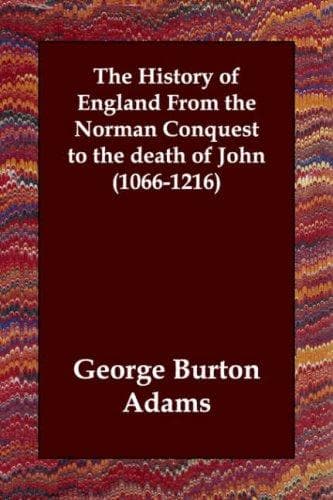
The History of England from the Norman Conquest to the Death of John (1066-1216)Adams, George Burton
History
The History of England from the Norman Conquest to the Death of John (1066-1216)
Adams, George Burton
Great Britain -- History -- Medieval period, 1066-1485
The insurrection was in appearance an exceedingly dangerous one. Almost
every Norman baron in England revolted and carried his vassals with him.
Odo, Bishop of Bayeux, the king's uncle, was the prime mover in the
affair. He had been released from his prison by the Conqueror on his
death-bed, and had been restored by William II to his earldom of Kent;
but his hope of becoming the chief counsellor of the king, as he had
become of Robert in Normandy, was disappointed. With him was his brother,
Robert of Cornwall, Count of Mortain. The other great baron-bishop of the
Conquest, Geoffrey of Coutances, was also in insurrection, and with him
his nephew, Robert of Mowbray, Earl of Northumberland. Another leading
rebel was Roger, Earl of Shrewsbury, with his three sons, the chief of
whom, Robert of Bellême, was sent over from Normandy by Duke Robert, with
Eustace of Boulogne, to aid the insurrection in England until he should
himself be able to cross the channel. The treason of one man, William of
St. Calais, Bishop of Durham, was regarded by the English writers as
particularly heinous, if indeed we are right in referring their words to
him and not to Bishop Odo; it is at least evident from the sequel that
the king regarded his conduct in that light. The reason is not altogether
clear, unless it be that the position of greatest influence in England,
which Bishop Odo had desired in vain, had been given him by the king.
Other familiar names must be added to these: William of Eu, Roger of
Lacy, Ralph of Mortimer, Roger Bigod, Hugh of Grantmesnil. On the king's
side there were few Norman names to equal these: Hugh of Avranches, Earl
of Chester, William of Warenne, and of course the vassals of the great
Archbishop Lanfranc. But the real strength of the king was not derived
from the baronial elements. The castles in most of the great towns
remained faithful, and so did nearly all the bishops and the Church as a
whole. But the weight which turned the scale and gave the decision to the
king, was the support of the great mass of the nation, of the English as
opposed to the Norman.
Public-domain text, read in full here on John Shaqi.
Reviews
Reviews
No reviews yet
Be the first to share your thoughts on this work.
Elsewhere in the archive
Join the Discussion
Join the discussion
Sign in to leave a comment or review.
Sign InorCreate an account