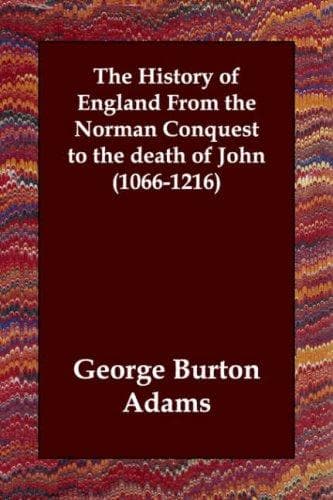
The History of England from the Norman Conquest to the Death of John (1066-1216)Adams, George Burton
History
The History of England from the Norman Conquest to the Death of John (1066-1216)
Adams, George Burton
Great Britain -- History -- Medieval period, 1066-1485
Tunbridge castle, which was held for Odo, was first stormed, and on the
news of this Odo thought it prudent to betake himself to Pevensey, where
his brother, Robert of Mortain, was, and where reinforcements from Robert
of Normandy would be likely to land. William at once turned from his
march to Rochester and began the siege of Pevensey. The Norman
reinforcements which Robert finally sent were driven back with great
loss, and after some weeks Pevensey was compelled to surrender. Bishop
Odo agreed to secure the surrender of Rochester, and then to retire from
England, only to return if the king should send for him. But William
unwisely sent him on to Rochester with a small advance detachment, to
occupy the castle, while he himself followed more slowly with the main
body. The castle refused to surrender. Odo's expression of face made
known his real wishes, and was more convincing than his words. A sudden
sally of the garrison overpowered his guards, and the bishop was carried
into the castle to try the fortune of a siege once more. For this siege
the king again appealed to the country and called for the help of all
under the old Saxon penalty of the disgraceful name of "nithing." The
defenders of the castle suffered greatly from the blockade, and were soon
compelled to yield upon such terms as the king pleased, who was with
difficulty persuaded to give up his first idea of sending them all to the
gallows.
The monk Orderic Vitalis, who wrote an account of these events a
generation after they occurred, was struck with one characteristic of
this insurrection, which the careful observer of any time would hardly
fail to notice. He says: "The rebels, although they were so many and
abundantly furnished with arms and supplies, did not dare to join battle
with the king in his kingdom." It was an age, to be sure, when wars were
decided less by fighting in the open field than by the siege and defence
of castles; and yet the collapse of so formidable an insurrection as
this, after no resistance at all in proportion to its apparent fighting
strength, is surely a significant fact. To notice here but one inference
from it, it means that no one questioned the title of William Rufus to
the throne while he was in possession. Though he might be a younger son,
not elected, but appointed by his father, and put into the kingship by
the act of the primate alone, he was, to the rebellious barons as to his
own supporters, the rightful king of England till he could be overthrown.
Public-domain text, read in full here on John Shaqi.
Reviews
Reviews
No reviews yet
Be the first to share your thoughts on this work.
Elsewhere in the archive
Join the Discussion
Join the discussion
Sign in to leave a comment or review.
Sign InorCreate an account