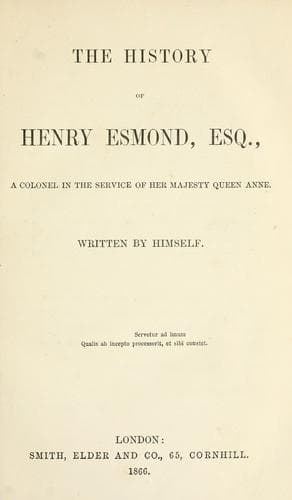
The History of Henry Esmond, Esq., a Colonel in the Service of Her Majesty Queen AnneThackeray, William Makepeace
History
The History of Henry Esmond, Esq., a Colonel in the Service of Her Majesty Queen Anne
Thackeray, William Makepeace
Great Britain -- History -- Anne, 1702-1714 -- Fiction; Historical fiction
The party of prisoners lived very well in Newgate, and with comforts
very different to those which were awarded to the poor wretches there
(his insensibility to their misery, their gayety still more frightful,
their curses and blasphemy, hath struck with a kind of shame since--as
proving how selfish, during his imprisonment, his own particular grief
was, and how entirely the thoughts of it absorbed him): if the three
gentlemen lived well under the care of the Warden of Newgate, it was
because they paid well: and indeed the cost at the dearest ordinary
or the grandest tavern in London could not have furnished a longer
reckoning, than our host of the “Handcuff Inn”--as Colonel Westbury
called it. Our rooms were the three in the gate over Newgate--on the
second story looking up Newgate Street towards Cheapside and Paul's
Church. And we had leave to walk on the roof, and could see thence
Smithfield and the Bluecoat Boys' School, Gardens, and the Chartreux,
where, as Harry Esmond remembered, Dick the Scholar, and his friend Tom
Tusher, had had their schooling.
Harry could never have paid his share of that prodigious heavy reckoning
which my landlord brought to his guests once a week: for he had but
three pieces in his pockets that fatal night before the duel, when the
gentlemen were at cards, and offered to play five. But whilst he was yet
ill at the Gatehouse, after Lady Castlewood had visited him there, and
before his trial, there came one in an orange-tawny coat and blue lace,
the livery which the Esmonds always wore, and brought a sealed packet
for Mr. Esmond, which contained twenty guineas, and a note saying that
a counsel had been appointed for him, and that more money would be
forthcoming whenever he needed it.
'Twas a queer letter from the scholar as she was, or as she called
herself: the Dowager Viscountess Castlewood, written in the strange
barbarous French which she and many other fine ladies of that
time--witness her Grace of Portsmouth--employed. Indeed, spelling was
not an article of general commodity in the world then, and my Lord
Marlborough's letters can show that he, for one, had but a little share
of this part of grammar:--
Public-domain text, read in full here on John Shaqi.
Reviews
Reviews
No reviews yet
Be the first to share your thoughts on this work.
Elsewhere in the archive
Join the Discussion
Join the discussion
Sign in to leave a comment or review.
Sign InorCreate an account