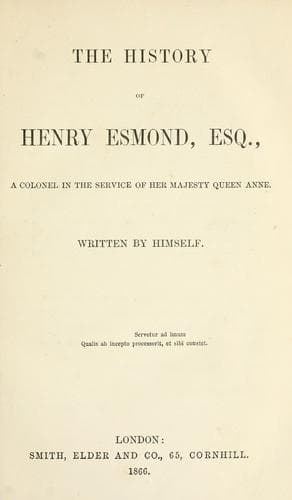
The History of Henry Esmond, Esq., a Colonel in the Service of Her Majesty Queen AnneThackeray, William Makepeace
History
The History of Henry Esmond, Esq., a Colonel in the Service of Her Majesty Queen Anne
Thackeray, William Makepeace
Great Britain -- History -- Anne, 1702-1714 -- Fiction; Historical fiction
Mr. Esmond's commission was scarce three weeks old when that accident
befell King William which ended the life of the greatest, the wisest,
the bravest, and most clement sovereign whom England ever knew.
'Twas the fashion of the hostile party to assail this great prince's
reputation during his life; but the joy which they and all his enemies
in Europe showed at his death, is a proof of the terror in which they
held him. Young as Esmond was, he was wise enough (and generous enough
too, let it be said) to scorn that indecency of gratulation which broke
out amongst the followers of King James in London, upon the death of
this illustrious prince, this invincible warrior, this wise and moderate
statesman. Loyalty to the exiled king's family was traditional, as has
been said, in that house to which Mr. Esmond belonged. His father's
widow had all her hopes, sympathies, recollections, prejudices, engaged
on King James's side; and was certainly as noisy a conspirator as ever
asserted the King's rights, or abused his opponent's, over a
quadrille table or a dish of bohea. Her ladyship's house swarmed with
ecclesiastics, in disguise and out; with tale-bearers from St. Germains;
and quidnuncs that knew the last news from Versailles; nay, the exact
force and number of the next expedition which the French king was to
send from Dunkirk, and which was to swallow up the Prince of Orange, his
army and his court. She had received the Duke of Berwick when he landed
here in '96. She kept the glass he drank from, vowing she never would
use it till she drank King James the Third's health in it on his
Majesty's return; she had tokens from the Queen, and relics of the saint
who, if the story was true, had not always been a saint as far as she
and many others were concerned. She believed in the miracles wrought at
his tomb, and had a hundred authentic stories of wondrous cures effected
by the blessed king's rosaries, the medals which he wore, the locks of
his hair, or what not. Esmond remembered a score of marvellous tales
which the credulous old woman told him. There was the Bishop of Autun,
that was healed of a malady he had for forty years, and which left
him after he said mass for the repose of the king's soul. There was M.
Marais, a surgeon in Auvergne, who had a palsy in both his legs, which
was cured through the king's intercession. There was Philip Pitet, of
the Benedictines, who had a suffocating cough, which wellnigh
killed him, but he besought relief of heaven through the merits and
intercession of the blessed king, and he straightway felt a profuse
sweat breaking out all over him, and was recovered perfectly. And
there was the wife of Mons. Lepervier, dancing-master to the Duke
of Saxe-Gotha, who was entirely eased of a rheumatism by the king's
intercession, of which miracle there could be no doubt, for her surgeon
and his apprentice had given their testimony, under oath, that they did
not in any way contribute to the cure. Of these tales, and a thousand
Public-domain text, read in full here on John Shaqi.
Reviews
Reviews
No reviews yet
Be the first to share your thoughts on this work.
Elsewhere in the archive
Join the Discussion
Join the discussion
Sign in to leave a comment or review.
Sign InorCreate an account