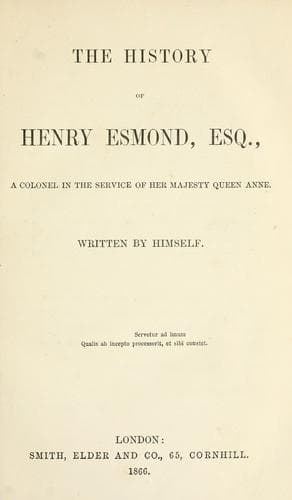
The History of Henry Esmond, Esq., a Colonel in the Service of Her Majesty Queen AnneThackeray, William Makepeace
History
The History of Henry Esmond, Esq., a Colonel in the Service of Her Majesty Queen Anne
Thackeray, William Makepeace
Great Britain -- History -- Anne, 1702-1714 -- Fiction; Historical fiction
Mr. Webb thought these verses quite as fine as Mr. Addison's on the
Blenheim Campaign, and, indeed, to be Hector a la mode de Paris, was
part of this gallant gentleman's ambition. It would have been difficult
to find an officer in the whole army, or amongst the splendid courtiers
and cavaliers of the Maison du Roy, that fought under Vendosme and
Villeroy in the army opposed to ours, who was a more accomplished
soldier and perfect gentleman, and either braver or better-looking.
And if Mr. Webb believed of himself what the world said of him, and was
deeply convinced of his own indisputable genius, beauty, and valor, who
has a right to quarrel with him very much? This self-content of his kept
him in general good-humor, of which his friends and dependants got the
benefit.
He came of a very ancient Wiltshire family, which he respected above all
families in the world: he could prove a lineal descent from King Edward
the First, and his first ancestor, Roaldus de Richmond, rode by William
the Conqueror's side on Hastings field. “We were gentlemen, Esmond,” he
used to say, “when the Churchills were horse-boys.” He was a very
tall man, standing in his pumps six feet three inches (in his great
jack-boots, with his tall fair periwig, and hat and feather, he could
not have been less than eight feet high). “I am taller than Churchill,”
he would say, surveying himself in the glass, “and I am a better made
man; and if the women won't like a man that hasn't a wart on his nose,
faith, I can't help myself, and Churchill has the better of me there.”
Indeed, he was always measuring himself with the Duke, and always asking
his friends to measure them. And talking in this frank way, as he would
do, over his cups, wags would laugh and encourage him; friends would
be sorry for him; schemers and flatterers would egg him on, and
tale-bearers carry the stories to headquarters, and widen the difference
which already existed there, between the great captain and one of the
ablest and bravest lieutenants he ever had.
His rancor against the Duke was so apparent, that one saw it in the
first half-hour's conversation with General Webb; and his lady, who
adored her General, and thought him a hundred times taller, handsomer,
and braver than a prodigal nature had made him, hated the great Duke
with such an intensity as it becomes faithful wives to feel against
their husbands' enemies. Not that my Lord Duke was so yet; Mr. Webb had
said a thousand things against him, which his superior had pardoned; and
his Grace, whose spies were everywhere, had heard a thousand things more
that Webb had never said. But it cost this great man no pains to pardon;
and he passed over an injury or a benefit alike easily.
Public-domain text, read in full here on John Shaqi.
Reviews
Reviews
No reviews yet
Be the first to share your thoughts on this work.
Elsewhere in the archive
Join the Discussion
Join the discussion
Sign in to leave a comment or review.
Sign InorCreate an account