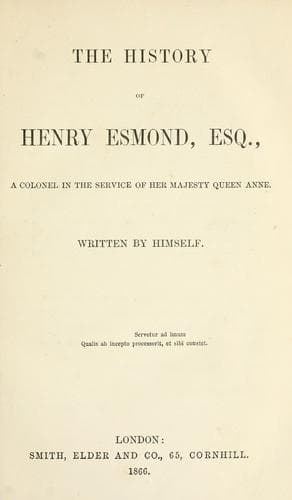
The History of Henry Esmond, Esq., a Colonel in the Service of Her Majesty Queen AnneThackeray, William Makepeace
History
The History of Henry Esmond, Esq., a Colonel in the Service of Her Majesty Queen Anne
Thackeray, William Makepeace
Great Britain -- History -- Anne, 1702-1714 -- Fiction; Historical fiction
This passion did not escape--how should it?--the clear eyes of Esmond's
mistress: he told her all; what will a man not do when frantic with
love? To what baseness will he not demean himself? What pangs will he
not make others suffer, so that he may ease his selfish heart of a part
of its own pain? Day after day he would seek his dear mistress, pour
insane hopes, supplications, rhapsodies, raptures, into her ear. She
listened, smiled, consoled, with untiring pity and sweetness. Esmond was
the eldest of her children, so she was pleased to say; and as for her
kindness, who ever had or would look for aught else from one who was
an angel of goodness and pity? After what has been said, 'tis needless
almost to add that poor Esmond's suit was unsuccessful. What was a
nameless, penniless lieutenant to do, when some of the greatest in
the land were in the field? Esmond never so much as thought of asking
permission to hope so far above his reach as he knew this prize was
and passed his foolish, useless life in mere abject sighs and impotent
longing. What nights of rage, what days of torment, of passionate
unfulfilled desire, of sickening jealousy can he recall! Beatrix
thought no more of him than of the lackey that followed her chair. His
complaints did not touch her in the least; his raptures rather fatigued
her; she cared for his verses no more than for Dan Chaucer's, who's
dead these ever so many hundred years; she did not hate him; she rather
despised him, and just suffered him.
One day, after talking to Beatrix's mother, his dear, fond, constant
mistress--for hours--for all day long--pouring out his flame and his
passion, his despair and rage, returning again and again to the theme,
pacing the room, tearing up the flowers on the table, twisting and
breaking into bits the wax out of the stand-dish, and performing a
hundred mad freaks of passionate folly; seeing his mistress at last
quite pale and tired out with sheer weariness of compassion, and
watching over his fever for the hundredth time, Esmond seized up his
hat, and took his leave. As he got into Kensington Square, a sense of
remorse came over him for the wearisome pain he had been inflicting upon
the dearest and kindest friend ever man had. He went back to the house,
where the servant still stood at the open door, ran up the stairs, and
found his mistress where he had left her in the embrasure of the window,
looking over the fields towards Chelsey. She laughed, wiping away at the
same time the tears which were in her kind eyes; he flung himself down
on his knees, and buried his head in her lap. She had in her hand the
stalk of one of the flowers, a pink, that he had torn to pieces. “Oh,
pardon me, pardon me, my dearest and kindest,” he said; “I am in hell,
and you are the angel that brings me a drop of water.”
Public-domain text, read in full here on John Shaqi.
Reviews
Reviews
No reviews yet
Be the first to share your thoughts on this work.
Elsewhere in the archive
Join the Discussion
Join the discussion
Sign in to leave a comment or review.
Sign InorCreate an account