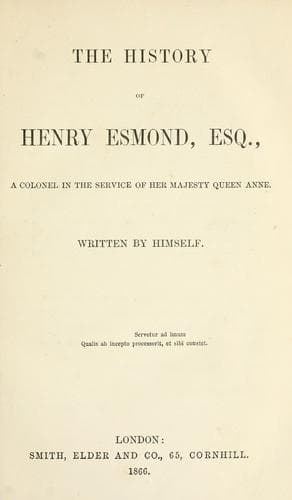
The History of Henry Esmond, Esq., a Colonel in the Service of Her Majesty Queen AnneThackeray, William Makepeace
History
The History of Henry Esmond, Esq., a Colonel in the Service of Her Majesty Queen Anne
Thackeray, William Makepeace
Great Britain -- History -- Anne, 1702-1714 -- Fiction; Historical fiction
During the whole of the year which succeeded that in which the glorious
battle of Ramillies had been fought, our army made no movement of
importance, much to the disgust of very many of our officers remaining
inactive in Flanders, who said that his Grace the Captain-General had
had fighting enough, and was all for money now, and the enjoyment of his
five thousand a year and his splendid palace at Woodstock, which was
now being built. And his Grace had sufficient occupation fighting his
enemies at home this year, where it began to be whispered that his favor
was decreasing, and his duchess losing her hold on the Queen, who was
transferring her royal affections to the famous Mrs. Masham, and Mrs.
Masham's humble servant, Mr. Harley. Against their intrigues, our Duke
passed a great part of his time intriguing. Mr. Harley was got out
of office, and his Grace, in so far, had a victory. But her Majesty,
convinced against her will, was of that opinion still, of which the poet
says people are when so convinced, and Mr. Harley before long had his
revenge.
Meanwhile the business of fighting did not go on any way to the
satisfaction of Marlborough's gallant lieutenants. During all 1707,
with the French before us, we had never so much as a battle; our army in
Spain was utterly routed at Almanza by the gallant Duke of Berwick; and
we of Webb's, which regiment the young Duke had commanded before his
father's abdication, were a little proud to think that it was our
colonel who had achieved this victory. “I think if I had had Galway's
place, and my Fusileers,” says our General, “we would not have laid down
our arms, even to our old colonel, as Galway did;” and Webb's officers
swore if we had had Webb, at least we would not have been taken
prisoners. Our dear old general talked incautiously of himself and of
others; a braver or a more brilliant soldier never lived than he; but
he blew his honest trumpet rather more loudly than became a commander of
his station, and, mighty man of valor as he was, shook his great spear
and blustered before the army too fiercely.
Public-domain text, read in full here on John Shaqi.
Reviews
Reviews
No reviews yet
Be the first to share your thoughts on this work.
Elsewhere in the archive
Join the Discussion
Join the discussion
Sign in to leave a comment or review.
Sign InorCreate an account