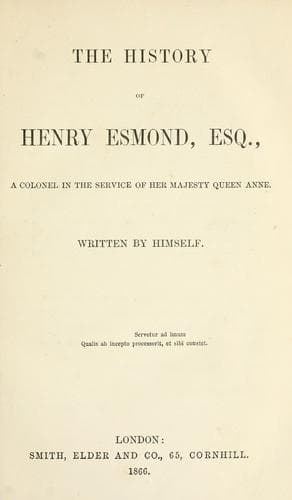
The History of Henry Esmond, Esq., a Colonel in the Service of Her Majesty Queen AnneThackeray, William Makepeace
History
The History of Henry Esmond, Esq., a Colonel in the Service of Her Majesty Queen Anne
Thackeray, William Makepeace
Great Britain -- History -- Anne, 1702-1714 -- Fiction; Historical fiction
The business relative to the exchange of prisoners was always going on,
and was at least that ostensible one which kept Mr. Holtz perpetually on
the move between the forces of the French and the Allies. I can answer
for it, that he was once very near hanged as a spy by Major-General
Wayne, when he was released and sent on to head-quarters by a special
order of the Commander-in-Chief. He came and went, always favored,
wherever he was, by some high though occult protection. He carried
messages between the Duke of Berwick and his uncle, our Duke. He seemed
to know as well what was taking place in the Prince's quarter as our
own: he brought the compliments of the King of England to some of our
officers, the gentlemen of Webb's among the rest, for their behavior on
that great day; and after Wynendael, when our General was chafing at the
neglect of our Commander-in-Chief, he said he knew how that action
was regarded by the chiefs of the French army, and that the stand made
before Wynendael wood was the passage by which the Allies entered Lille.
“Ah!” says Holtz (and some folks were very willing to listen to him),
“if the king came by his own, how changed the conduct of affairs would
be! His Majesty's very exile has this advantage, that he is enabled to
read England impartially, and to judge honestly of all the eminent men.
His sister is always in the hand of one greedy favorite or another,
through whose eyes she sees, and to whose flattery or dependants she
gives away everything. Do you suppose that his Majesty, knowing England
so well as he does, would neglect such a man as General Webb? He ought
to be in the House of Peers as Lord Lydiard. The enemy and all Europe
know his merit; it is that very reputation which certain great people,
who hate all equality and independence, can never pardon.” It was
intended that these conversations should be carried to Mr. Webb. They
were welcome to him, for great as his services were, no man could value
them more than John Richmond Webb did himself, and the differences
between him and Marlborough being notorious, his Grace's enemies in
the army and at home began to court Webb, and set him up against
the all-grasping, domineering chief. And soon after the victory of
Oudenarde, a glorious opportunity fell into General Webb's way, which
that gallant warrior did not neglect, and which gave him the means of
immensely increasing his reputation at home.
Public-domain text, read in full here on John Shaqi.
Reviews
Reviews
No reviews yet
Be the first to share your thoughts on this work.
Elsewhere in the archive
Join the Discussion
Join the discussion
Sign in to leave a comment or review.
Sign InorCreate an account