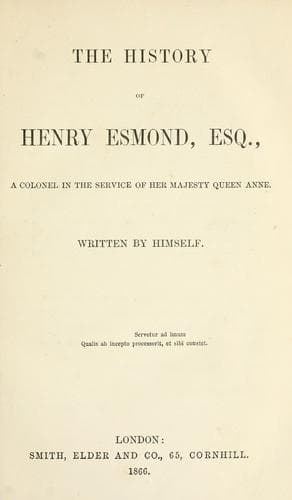
The History of Henry Esmond, Esq., a Colonel in the Service of Her Majesty Queen AnneThackeray, William Makepeace
History
The History of Henry Esmond, Esq., a Colonel in the Service of Her Majesty Queen Anne
Thackeray, William Makepeace
Great Britain -- History -- Anne, 1702-1714 -- Fiction; Historical fiction
Mr. Webb, reading the Gazette, looked very strange--slapped it down
on the table--then sprang up in his place, and began to--“Will your
Highness please to--”
His Grace the Duke of Marlborough here jumped up too--“There's some
mistake, my dear General Webb.”
“Your Grace had better rectify it,” says Mr. Webb, holding out the
letter; but he was five off his Grace the Prince Duke, who, besides,
was higher than the General (being seated with the Prince of Savoy,
the Electoral Prince of Hanover, and the envoys of Prussia and Denmark,
under a baldaquin), and Webb could not reach him, tall as he was.
“Stay,” says he, with a smile, as if catching at some idea, and then,
with a perfect courtesy, drawing his sword, he ran the Gazette through
with the point, and said, “Permit me to hand it to your Grace.”
The Duke looked very black. “Take it,” says he, to his Master of the
Horse, who was waiting behind him.
The Lieutenant-General made a very low bow, and retired and finished his
glass. The Gazette in which Mr. Cardonnel, the Duke's secretary, gave an
account of the victory of Wynendael, mentioned Mr. Webb's name, but gave
the sole praise and conduct of the action to the Duke's favorite, Mr.
Cadogan.
There was no little talk and excitement occasioned by this strange
behavior of General Webb, who had almost drawn a sword upon the
Commander-in-Chief; but the General, after the first outbreak of
his anger, mastered it outwardly altogether; and, by his
subsequent behavior, had the satisfaction of even more angering the
Commander-in-Chief, than he could have done by any public exhibition of
resentment.
On returning to his quarters, and consulting with his chief adviser, Mr.
Esmond, who was now entirely in the General's confidence, and treated by
him as a friend, and almost a son, Mr. Webb writ a letter to his Grace
the Commander-in-Chief, in which he said:--
“Your Grace must be aware that the sudden perusal of the London
Gazette, in which your Grace's secretary, Mr. Cardonnel, hath mentioned
Major-General Cadogan's name as the officer commanding in the late
action of Wynendael, must have caused a feeling of anything but pleasure
to the General who fought that action.
“Your Grace must be aware that Mr. Cadogan was not even present at the
battle, though he arrived with squadrons of horse at its close, and put
himself under the command of his superior officer. And as the result of
the battle of Wynendael, in which Lieutenant-General Webb had the good
fortune to command, was the capture of Lille, the relief of Brussels,
then invested by the enemy under the Elector of Bavaria, the restoration
of the great cities of Ghent and Bruges, of which the enemy (by treason
within the walls) had got possession in the previous year, Mr. Webb
cannot consent to forego the honors of such a success and service, for
the benefit of Mr. Cadogan, or any other person.
Public-domain text, read in full here on John Shaqi.
Reviews
Reviews
No reviews yet
Be the first to share your thoughts on this work.
Elsewhere in the archive
Join the Discussion
Join the discussion
Sign in to leave a comment or review.
Sign InorCreate an account