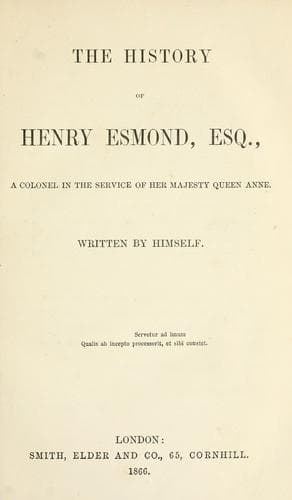
The History of Henry Esmond, Esq., a Colonel in the Service of Her Majesty Queen AnneThackeray, William Makepeace
History
The History of Henry Esmond, Esq., a Colonel in the Service of Her Majesty Queen Anne
Thackeray, William Makepeace
Great Britain -- History -- Anne, 1702-1714 -- Fiction; Historical fiction
Besides the Captain and his lady, there was a great and notable
assemblage of company: my Lady of Chelsey having sent her lackeys
and liveries to aid the modest attendance at Kensington. There was
Lieutenant-General Webb, Harry's kind patron, of whom the Dowager
took possession, and who resplended in velvet and gold lace; there was
Harry's new acquaintance, the Right Honorable Henry St. John, Esquire,
the General's kinsman, who was charmed with the Lady Castlewood, even
more than with her daughter; there was one of the greatest noblemen in
the kingdom, the Scots Duke of Hamilton, just created Duke of Brandon
in England; and two other noble lords of the Tory party, my Lord
Ashburnham, and another I have forgot; and for ladies, her Grace the
Duchess of Ormonde and her daughters, the Lady Mary and the Lady Betty,
the former one of Mistress Beatrix's colleagues in waiting on the Queen.
“What a party of Tories!” whispered Captain Steele to Esmond, as we were
assembled in the parlor before dinner. Indeed, all the company present,
save Steele, were of that faction.
Mr. St. John made his special compliments to Mrs. Steele, and so charmed
her that she declared she would have Steele a Tory too.
“Or will you have me a Whig?” says Mr. St. John. “I think, madam, you
could convert a man to anything.”
“If Mr. St. John ever comes to Bloomsbury Square I will teach him what
I know,” says Mrs. Steele, dropping her handsome eyes. “Do you know
Bloomsbury Square?”
“Do I know the Mall? Do I know the Opera? Do I know the reigning toast?
Why, Bloomsbury is the very height of the mode,” says Mr. St. John.
“'Tis rus in urbe. You have gardens all the way to Hampstead, and
palaces round about you--Southampton House and Montague House.”
“Where you wretches go and fight duels,” cries Mrs. Steele.
“Of which the ladies are the cause!” says her entertainer. “Madam, is
Dick a good swordsman? How charming the 'Tatler' is! We all recognized
your portrait in the 49th number, and I have been dying to know you
ever since I read it. 'Aspasia must be allowed to be the first of
the beauteous order of love.' Doth not the passage run so? 'In this
accomplished lady love is the constant effect, though it is never the
design; yet though her mien carries much more invitation than command,
to behold her is an immediate check to loose behavior, and to love her
is a liberal education.'”
“Oh, indeed!” says Mrs. Steele, who did not seem to understand a word of
what the gentleman was saying.
“Who could fail to be accomplished under such a mistress?” says Mr. St.
John, still gallant and bowing.
“Mistress! upon my word, sir!” cries the lady. “If you mean me, sir, I
would have you know that I am the Captain's wife.”
“Sure we all know it,” answers Mr. St. John, keeping his countenance
very gravely; and Steele broke in saying, “'Twas not about Mrs. Steele I
writ that paper--though I am sure she is worthy of any compliment I can
pay her--but of the Lady Elizabeth Hastings.”
Public-domain text, read in full here on John Shaqi.
Reviews
Reviews
No reviews yet
Be the first to share your thoughts on this work.
Elsewhere in the archive
Join the Discussion
Join the discussion
Sign in to leave a comment or review.
Sign InorCreate an account