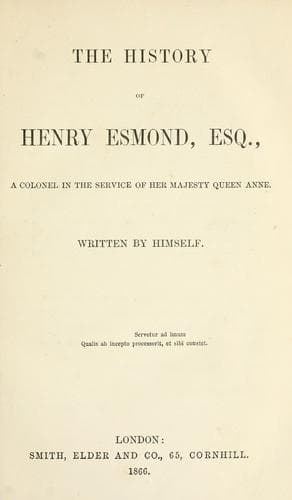
The History of Henry Esmond, Esq., a Colonel in the Service of Her Majesty Queen AnneThackeray, William Makepeace
History
The History of Henry Esmond, Esq., a Colonel in the Service of Her Majesty Queen Anne
Thackeray, William Makepeace
Great Britain -- History -- Anne, 1702-1714 -- Fiction; Historical fiction
So Frank had married a Roman Catholic lady, and an heir was expected,
and Mr. Esmond was to carry this intelligence to his mistress at London.
'Twas a difficult embassy; and the Colonel felt not a little tremor as
he neared the capital.
He reached his inn late, and sent a messenger to Kensington to announce
his arrival and visit the next morning. The messenger brought back news
that the Court was at Windsor, and the fair Beatrix absent and engaged
in her duties there. Only Esmond's mistress remained in her house at
Kensington. She appeared in court but once in the year; Beatrix was
quite the mistress and ruler of the little mansion, inviting the company
thither, and engaging in every conceivable frolic of town pleasure.
Whilst her mother, acting as the young lady's protectress and elder
sister, pursued her own path, which was quite modest and secluded.
As soon as ever Esmond was dressed (and he had been awake long before
the town), he took a coach for Kensington, and reached it so early that
he met his dear mistress coming home from morning prayers. She carried
her prayer-book, never allowing a footman to bear it, as everybody else
did: and it was by this simple sign Esmond knew what her occupation had
been. He called to the coachman to stop, and jumped out as she looked
towards him. She wore her hood as usual, and she turned quite pale when
she saw him. To feel that kind little hand near to his heart seemed
to give him strength. They were soon at the door of her ladyship's
house--and within it.
With a sweet sad smile she took his hand and kissed it.
“How ill you have been: how weak you look, my dear Henry,” she said.
'Tis certain the Colonel did look like a ghost, except that ghosts do
not look very happy, 'tis said. Esmond always felt so on returning to
her after absence, indeed whenever he looked in her sweet kind face.
“I am come back to be nursed by my family,” says he. “If Frank had
not taken care of me after my wound, very likely I should have gone
altogether.”
“Poor Frank, good Frank!” says his mother. “You'll always be kind to
him, my lord,” she went on. “The poor child never knew he was doing you
a wrong.”
“My lord!” cries out Colonel Esmond. “What do you mean, dear lady?”
“I am no lady,” says she; “I am Rachel Esmond, Francis Esmond's widow,
my lord. I cannot bear that title. Would we never had taken it from him
who has it now. But we did all in our power, Henry: we did all in our
power; and my lord and I--that is--”
“Who told you this tale, dearest lady?” asked the Colonel.
“Have you not had the letter I writ you? I writ to you at Mons directly
I heard it,” says Lady Esmond.
Public-domain text, read in full here on John Shaqi.
Reviews
Reviews
No reviews yet
Be the first to share your thoughts on this work.
Elsewhere in the archive
Join the Discussion
Join the discussion
Sign in to leave a comment or review.
Sign InorCreate an account