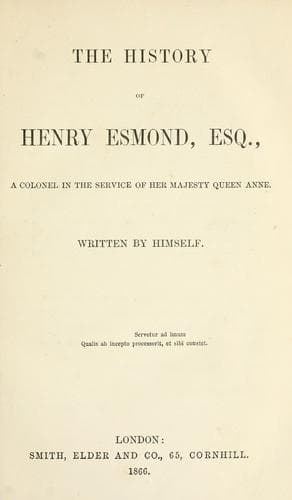
The History of Henry Esmond, Esq., a Colonel in the Service of Her Majesty Queen AnneThackeray, William Makepeace
History
The History of Henry Esmond, Esq., a Colonel in the Service of Her Majesty Queen Anne
Thackeray, William Makepeace
Great Britain -- History -- Anne, 1702-1714 -- Fiction; Historical fiction
This was the substance of the Dowager's revelation. Dean Atterbury had
knowledge of it, Lady Castlewood said, and Esmond very well knows how:
that divine being the clergyman for whom the late lord had sent on his
death-bed: and when Lady Castlewood would instantly have written to her
son, and conveyed the truth to him, the Dean's advice was that a letter
should be writ to Colonel Esmond rather; that the matter should be
submitted to his decision, by which alone the rest of the family were
bound to abide.
“And can my dearest lady doubt what that will be?” says the Colonel.
“It rests with you, Harry, as the head of our house.”
“It was settled twelve years since, by my dear lord's bedside,” says
Colonel Esmond. “The children must know nothing of this. Frank and his
heirs after him must bear our name. 'Tis his rightfully; I have not even
a proof of that marriage of my father and mother, though my poor lord,
on his death-bed, told me that Father Holt had brought such a proof to
Castlewood. I would not seek it when I was abroad. I went and looked at
my poor mother's grave in her convent. What matter to her now? No court
of law on earth, upon my mere word, would deprive my Lord Viscount and
set me up. I am the head of the house, dear lady; but Frank is Viscount
of Castlewood still. And rather than disturb him, I would turn monk, or
disappear in America.”
As he spoke so to his dearest mistress, for whom he would have been
willing to give up his life, or to make any sacrifice any day, the fond
creature flung herself down on her knees before him, and kissed both his
hands in an outbreak of passionate love and gratitude, such as could not
but melt his heart, and make him feel very proud and thankful that God
had given him the power to show his love for her, and to prove it by
some little sacrifice on his own part. To be able to bestow benefits
or happiness on those one loves is sure the greatest blessing conferred
upon a man--and what wealth or name, or gratification of ambition or
vanity, could compare with the pleasure Esmond now had of being able to
confer some kindness upon his best and dearest friends?
“Dearest saint,” says he--“purest soul, that has had so much to suffer,
that has blest the poor lonely orphan with such a treasure of love. 'Tis
for me to kneel, not for you: 'tis for me to be thankful that I can make
you happy. Hath my life any other aim? Blessed be God that I can serve
you! What pleasure, think you, could all the world give me compared to
that?”
“Don't raise me,” she said, in a wild way, to Esmond, who would have
lifted her. “Let me kneel--let me kneel, and--and--worship you.”
Public-domain text, read in full here on John Shaqi.
Reviews
Reviews
No reviews yet
Be the first to share your thoughts on this work.
Elsewhere in the archive
Join the Discussion
Join the discussion
Sign in to leave a comment or review.
Sign InorCreate an account