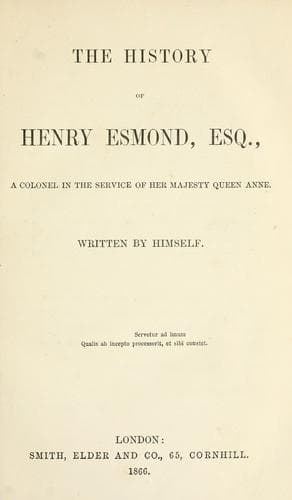
The History of Henry Esmond, Esq., a Colonel in the Service of Her Majesty Queen AnneThackeray, William Makepeace
History
The History of Henry Esmond, Esq., a Colonel in the Service of Her Majesty Queen Anne
Thackeray, William Makepeace
Great Britain -- History -- Anne, 1702-1714 -- Fiction; Historical fiction
When Mr. Esmond came home, his health was still shattered; and he took a
lodging near to his mistresses, at Kensington, glad enough to be served
by them, and to see them day after day. He was enabled to see a little
company--and of the sort he liked best. Mr. Steele and Mr. Addison both
did him the honor to visit him; and drank many a glass of good claret
at his lodging, whilst their entertainer, through his wound, was kept to
diet drink and gruel. These gentlemen were Whigs, and great admirers of
my Lord Duke of Marlborough; and Esmond was entirely of the other party.
But their different views of politics did not prevent the gentlemen from
agreeing in private, nor from allowing, on one evening when Esmond's
kind old patron, Lieutenant-General Webb, with a stick and a crutch,
hobbled up to the Colonel's lodging (which was prettily situate at
Knightsbridge, between London and Kensington, and looking over
the Gardens), that the Lieutenant-General was a noble and gallant
soldier--and even that he had been hardly used in the Wynendael affair.
He took his revenge in talk, that must be confessed; and if Mr. Addison
had had a mind to write a poem about Wynendael, he might have heard from
the commander's own lips the story a hundred times over.
Mr. Esmond, forced to be quiet, betook himself to literature for a
relaxation, and composed his comedy, whereof the prompter's copy lieth
in my walnut escritoire, sealed up and docketed, “The Faithful Fool,
a Comedy, as it was performed by her Majesty's Servants.” 'Twas a
very sentimental piece; and Mr. Steele, who had more of that kind of
sentiment than Mr. Addison, admired it, whilst the other rather sneered
at the performance; though he owned that, here and there, it contained
some pretty strokes. He was bringing out his own play of “Cato” at the
time, the blaze of which quite extinguished Esmond's farthing candle;
and his name was never put to the piece, which was printed as by a
Person of Quality. Only nine copies were sold, though Mr. Dennis, the
great critic, praised it, and said 'twas a work of great merit; and
Colonel Esmond had the whole impression burned one day in a rage, by
Jack Lockwood, his man.
Public-domain text, read in full here on John Shaqi.
Reviews
Reviews
No reviews yet
Be the first to share your thoughts on this work.
Elsewhere in the archive
Join the Discussion
Join the discussion
Sign in to leave a comment or review.
Sign InorCreate an account